


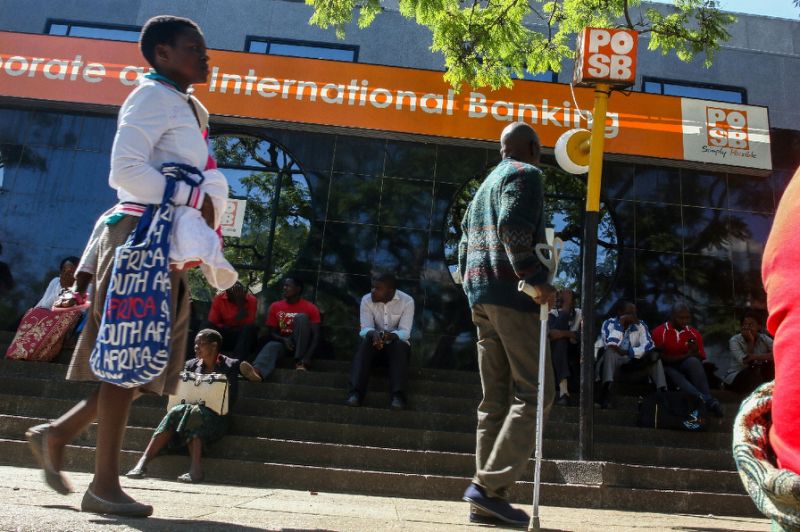
Cash crisis … Scores of people wait outside POSB bank in Harare
Zimbabwe has been struggling with a serious shortage of the US dollar which the country has used since ditching its own currency in 2009 after it had been rendered worthless by hyperinflation.
A visit to by NewZimbabwe.com to central Harare showed that indigenous banks were the worst affected by the cash shortages while no queues were evident at foreign-owned commercial banks such as Standard Chartered and Stanbic.
Most of the people said they had queued all day without getting their money and condemned the government for failing to end the crisis.
Gogo Manyanya from Goromonzi said she had joined a queue as early as 6am but lost hope of getting her money at around mid-day.
“We are in pain today; all the money that we worked for is being stashed into the bank but the government is doing nothing to help us.
“What about our grandchildren at home? This is not fair,†she lamented.
A furious Sekuru Nhira from Njanja in Chivhu said the government was not concerned about the plight of its people.
“My child, we don’t know what the problem is with our government,†he said.
“We are not even allowed to ask them what the problem is; they will just say – who do you think you are to challenge us.â€
He added: “We have been here (queuing) for more than three hours and this means we might spend most of the day waiting to get our money.â€
President Robert Mugabe last week told a meeting of his ruling Zanu PF party that bond notes which the government plans to introduce in October would help address the problem.
However, in an interview with NewZimbabwe.com, Economist Masimba Manyanya slammed the government for prioritising payments to the International Monetary Fund (IMF) rather than local workers.
The IMF has been working with the national treasury on addressing Zimbabwe’s multi-billion-dollar debt foreign debt as well as economic reforms.
Manyanya said the IMF gave misleading reports, claiming that the local economy was on the path to recovery.
“This glossy picture showed by IMF is not obtaining on the ground. Queues are a pure sign that something is not balancing well in the economy,†he said.
“The banks are trying to cope with the situation but they do not have proper strategies. People only queue for withdrawals and no deposits being are being made.
“The coming of the World Bank on Tuesday is another bit of bad news for this country … I do not expect anything good from World Bank’s visit next week.â€
He said the government should use local expertise instead of relying on foreign organisations for solutions to the country’s economic problems.
“We have enough information and experts to help the government with ideas and come up with plans that would help address the problems were are facing,†he said.
“It is very surprising that Zimbabwe is paying its loans to the IMF but failing to its workers’ salaries. This is very sad.â€
Post published in: Business