


By Andrew Field
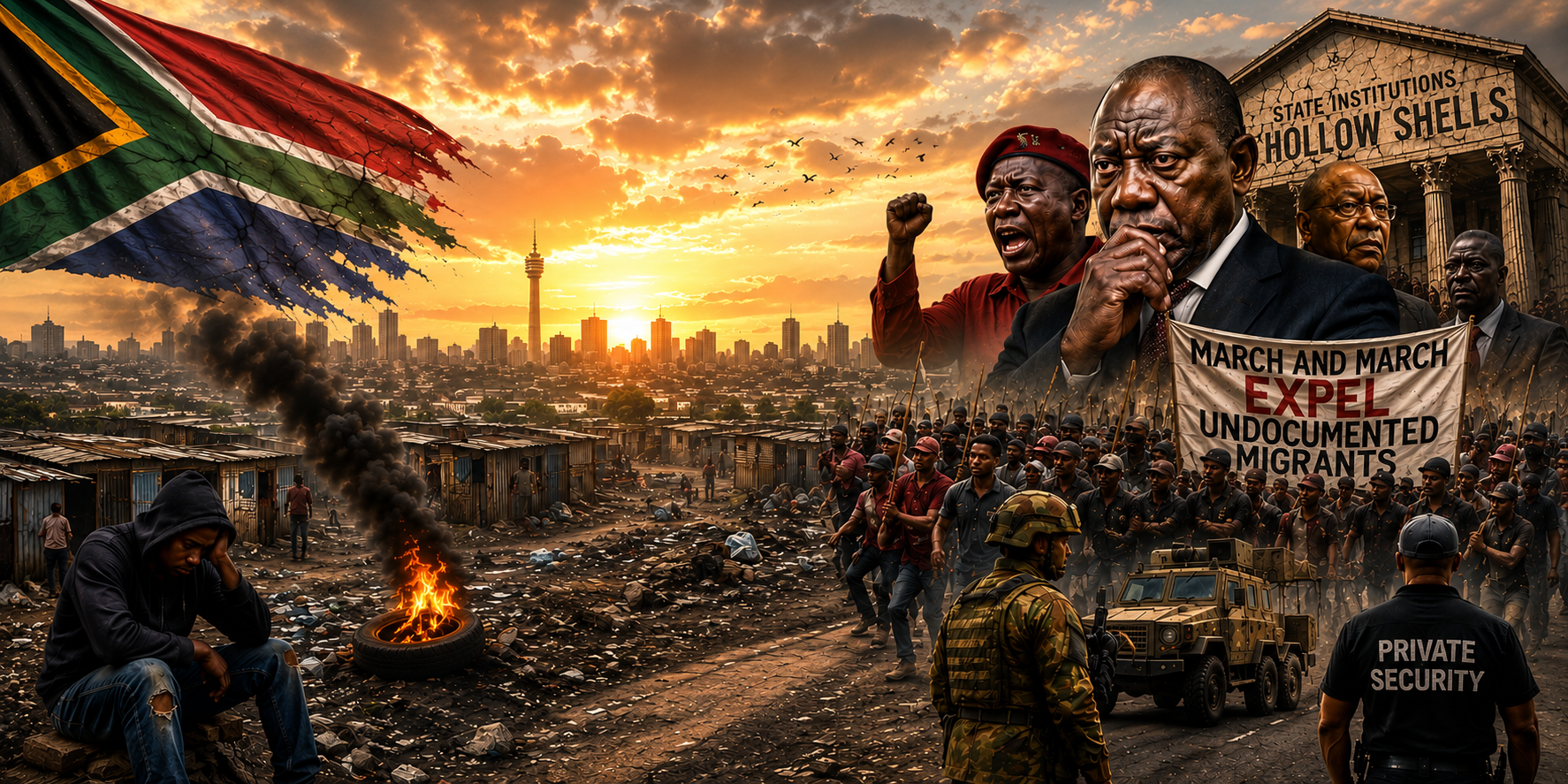
The 1994 majority rule and the rainbow nation promised a new dawn. Instead, it has been a trajectory of despair, hopelessness, and fear. Now, a civic movement called March and March threatens to shut the country down unless undocumented migrants are expelled. Eleven days before voter registration, four months before local elections, and six weeks after the Constitutional Court set President Cyril Ramaphosa on the path to impeachment, South Africa is not in crisis. It is something worse: crisis has become the permanent condition. Institutions hold their shape while their substance drains away.
The economy limps forward at 1.2 to 1.5 percent growth. Real GDP per capita is flat. Income per capita remains below 2007 levels. Unemployment sits at 31.4 percent, with youth unemployment at 43.8 percent — the powder keg behind xenophobic rage. Nearly 60 percent of South Africans live below the poverty line. The state props up 45 percent of the population with social grants it cannot afford. It is not a safety net, it is a pressure valve, and pressure valves do eventually blow.
Externally, South Africa is punished. U.S. tariffs bite. The African Growth and Opportunity Act (AGOA) limps toward expiry. Washington calls Broad-Based Black Economic Empowerment (BEE) racist and a barrier to trade. It is a hangover of victimhood mentality that seems not to be going away. The policy architecture meant to redress apartheid has become a geopolitical liability. A country that once exported confidence now exports citrus and wine under duress. An economy generating 1.5 percent growth cannot absorb a youth cohort of twenty million. It cannot fund its own military. It cannot close the fiscal deficit without cutting services on which nearly half the population depends. And it cannot produce the political legitimacy that comes from a citizen’s reasonable expectation that things will improve.
Internally, the Government of National Unity (GNU) is fragile. Formed after the African National Congress (ANC) fell to 40 percent in 2024, it now holds together ten parties that disagree on everything from land to migration. Ramaphosa is the glue — the reform narrative, the credit rating upgrade, the Financial Action Task Force (FATF) grey list removal. Remove him, and the GNU collapses. Yet impeachment looms. South Africans suffer the same filth of corrupt politicians as Zimbabweans do. It is endemic in Africa — the liberation movement’s dirtiest secret, that the struggle was never entirely about the people.
The November elections will expose the contradictions. The ANC campaigns against its coalition partner, the Democratic Alliance (DA). The South African Communist Party (SACP) contests independently. Jacob Zuma’s uMkhonto we Sizwe (MK) Party implodes. Julius Malema’s Economic Freedom Fighters (EFF) mobilise the unemployed youth — twelve million strong, most unregistered, most disengaged from the ballot box but not from protest and potentially violence. Rage is being courted, but rage not converted will find other outlets. Twelve million South Africans aged 18 to 29, only 4.5 million registered to vote, and of those unregistered, 62 percent have no intention of registering. In 2024, 11.5 million registered voters did not bother to cast a ballot. Add the unregistered and the figure approaches twenty million South Africans of voting age who will not participate in November. They are not apathetic. They protest, organise, burn tyres. They are the fuel of unrest.
The South African National Defence Force (SANDF) is a hollow shell. It cannot defend borders or neighbourhoods. What fills the vacuum is more interesting than a coup, and more difficult to contain. The SANDF is deployed domestically against organised crime in roles it is doctrinally unsuited for. A partisan militia network loosely attached to the MK veterans’ structures remains available to whoever can organise it, after thirty years of the ANC using it as a factional instrument. And South Africa’s private security sector, estimated at 400,000 to 500,000 personnel, armed, operating in every township and mine, and largely unaccountable in practice, outnumbers both the SANDF and the South African Police Service (SAPS) combined. Given the right patronage, and every general loves a flashy car, this combination remains a latent instrument of political leverage.
Patronage networks thrive while the state implodes. Meanwhile, the white minority fades from the political conversation. Once a fifth of the population (1960 census), now 7.1 percent. Skills and capital exit. Farm murders are tragic but not genocide. The Afrikaner ethno‑right is not driving the crisis, but it is another symptom of a state that has failed to make its citizens — all of them — believe their future lies within it. Nearly 95,000 white South Africans left between 2021 and 2026. Some return, but the net effect is decline. The tax base shrinks. The skills pool evaporates. The rainbow nation bleeds colour.
Thirty‑two years after liberation, South Africa remains democracy in form, but hollow in substance. The courts still rule, elections will still be held, the GNU will stagger on. But the institutions are shells. Twenty million young people have concluded the ballot box is not their instrument. The military cannot defend a border. The president is in court to stop Parliament examining his conduct. Vigilantes issue ultimatums to foreign nationals.
This is not the rainbow nation Nelson Mandela envisioned. It is a fractured state, led by a political elite too busy protecting their own interests to harness the country’s vast potential. South Africa could have been the powerhouse of Africa, the happiest on the continent. Instead, it is a cautionary tale: a democracy that exists only in form, while the substance of hope, prosperity, and unity has been squandered. The ANC clings to power, the DA pretends to govern, Malema mobilises rage, and Ramaphosa fights for survival. The people are left with load‑shedding, unemployment, and broken promises. The political elite are messing up — bluntly, catastrophically, and without shame.
South Africa’s long road has no visible destination. The rainbow has faded, the dream has curdled. The country is not collapsing in a single dramatic moment but rotting in slow motion. The political elite, meanwhile, are polishing their speeches and chauffeured cars, congratulating themselves on managing the decline with such dignity. They call it democracy; the people call it load-shedding. They call it reform; the unemployed call it hunger. They call it unity; the rest of us call it a con, run by men who discovered that the language of liberation is the perfect cover for the business of looting. Unless the leaders rediscover the courage to govern for the people rather than themselves, the only thing South Africa will power is the world’s darkest punchline.
Addendum
Postscript: Durban, June 2026
This essay was written as a projection. Events have not waited.
In Durban’s Sherwood Hall grounds, more than 8,000 Malawian nationals are living in open fields, mothers cradling babies, children huddled in the June cold, waiting for repatriation buses that cannot come fast enough. They are the visible tip of a crisis that has swept Johannesburg, Pretoria, Mossel Bay, and the Western Cape since April. Five Mozambicans have been killed in Mossel Bay. Nigeria has already flown its first 260 nationals home and expects a thousand more to follow. Ghana, Zimbabwe, Malawi and Mozambique have all activated emergency repatriation operations for their citizens in South Africa.
March and March’s June 30 deadline is nine days away. It has not caused this. It has legitimised it.
The pressure valve this article described has not blown. It is leaking — badly, in multiple places simultaneously, and the repair crews are nowhere to be seen. South African authorities insist the situation is under control. The 8,000 people sleeping in a Durban park suggest otherwise.
The long road has no destination. But it has a date. Nine days from now.
Post published in: Featured