


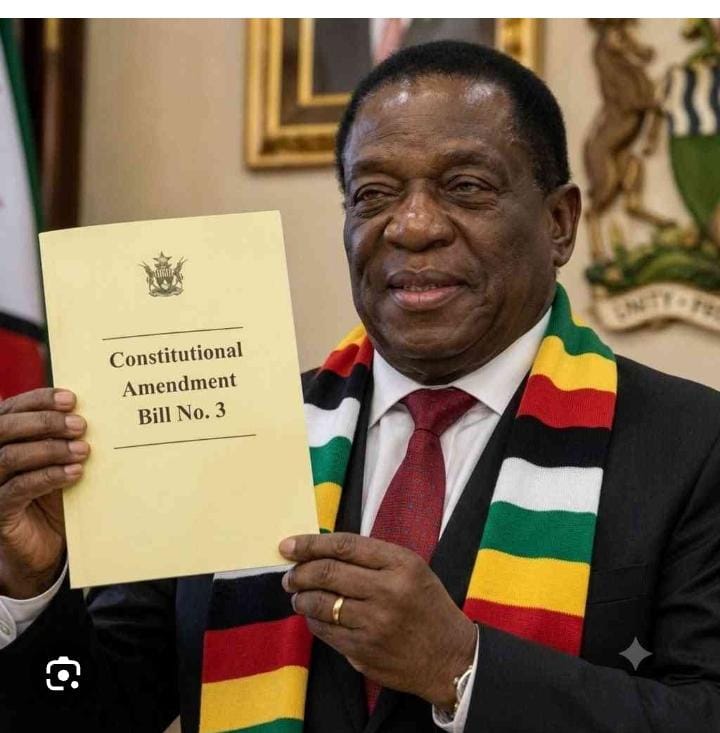
Legislative alignment is a necessary consequence of constitutional amendment. Our concern is not that Government is aligning legislation, but what the scale of that exercise reveals. By requiring the amendment of at least twelve Acts of Parliament, Government has confirmed that Amendment No. 3 was never a minor constitutional adjustment. It fundamentally reshaped Zimbabwe’s constitutional order.
The significance of this announcement lies not in the fact that laws are being aligned, but in the sheer magnitude of the alignment required. If implementing Amendment No. 3 requires the amendment of the Electoral Act, the Judicial Service Act, the Constitutional Court Act, the Supreme Court Act, the Defence Act, the Urban Councils Act, the Rural District Councils Act, the Traditional Leaders Act, the Attorney-General’s Office Act and several other statutes, together with the creation of entirely new legislative frameworks, then Government itself has demonstrated that Amendment No. 3 fundamentally reconfigures the constitutional order established by the people of Zimbabwe in 2013.
The alignment programme demonstrates that Amendment No. 3 reshapes:
- electoral governance, including the transfer of the voters’ roll and constituency delimitation;
- presidential succession and the extension of electoral terms;
- the structure of the judiciary;
- the composition of Parliament; and
- the framework governing constitutional commissions and other public institutions.
These are not isolated or technical amendments. They reshape the electoral system, the separation of powers, judicial administration, parliamentary representation and the exercise of sovereign authority. Government cannot simultaneously describe Amendment No. 3 as a limited constitutional adjustment while acknowledging that virtually every pillar of constitutional governance now requires legislative redesign.
Government’s own implementation programme has settled the debate. Changes of this magnitude—affecting how political power is acquired, exercised and transferred—require the direct consent of the people through a national referendum.
ZICOMO remains particularly concerned by the proposed transfer of responsibility for voter registration and maintenance of the voters’ roll from ZEC to the Registrar-General’s Office. One of the defining achievements of the 2013 Constitution was the establishment of an independent electoral management body responsible for administering the electoral process. Removing one of its core constitutional functions risks weakening institutional independence, reducing public confidence in electoral integrity and reversing important democratic gains.
Equally troubling is the decision to replace direct presidential by-elections with parliamentary election of a President whenever a vacancy arises. The office of President derives its democratic legitimacy directly from the people. Constitutional arrangements that distance citizens from choosing their Head of State weaken one of the most fundamental principles of constitutional democracy—that all political authority is derived from the people. Fundamental constitutional change derives its democratic legitimacy from the sovereign will of the people.
The Way Forward
With Amendment No. 3 now enacted, the constitutional struggle enters a new phase. The priority is no longer preventing the amendment but ensuring that its implementation remains subject to constitutional scrutiny, democratic accountability and active citizen participation.
Accordingly, ZICOMO will work with constitutional scholars, civil society organisations and citizens to:
- scrutinise every alignment Bill before Parliament;
- establish aConstitutional Observatory to monitor implementation;
- pursue strategic litigation where implementing legislation violates constitutional guarantees; and
- strengthen the People’s Coalition(Sungano yeVanhu–Ubumbano loMphakathi) as a broad national platform for defending constitutional democracy.
Beyond legislative scrutiny, Zimbabwe must begin a sustained national conversation on the future of its constitutional democracy. Amendment No. 3 should mark not the end of constitutional engagement, but the beginning of renewed civic education, public participation and democratic accountability. Constitutionalism survives only when citizens actively defend it.
As Parliament prepares to consider the series of Bills required to operationalise Amendment No. 3, ZICOMO calls upon Members of Parliament, civil society organisations, constitutional scholars, faith leaders, labour movements, professional associations and all Zimbabweans to participate actively in this process. Every alignment Bill should be publicly debated, independently analysed and constitutionally scrutinised before becoming law.
Zimbabwe deserves constitutional reforms that strengthen democratic institutions, not weaken them. As Zimbabwe approaches 31 July, ZICOMO reaffirms every citizen’s constitutional rights to freedom of expression, peaceful assembly and participation in public affairs. We respect the right of Zimbabweans to express their views through peaceful and lawful means and call upon the State to ensure these rights are exercised freely, peacefully and without intimidation, in accordance with the Constitution and the rule of law.
Government’s alignment programme has confirmed what many Zimbabweans argued throughout the Amendment No. 3 process: this was never an ordinary constitutional amendment but a fundamental reconfiguration of Zimbabwe’s constitutional order. The responsibility of this generation is therefore not only to defend the Constitution, but to defend the democratic values, institutions and principles upon which it rests.
Issued by: Zimbabwe Constitutional Movement (ZICOMO)
Post published in: Featured