


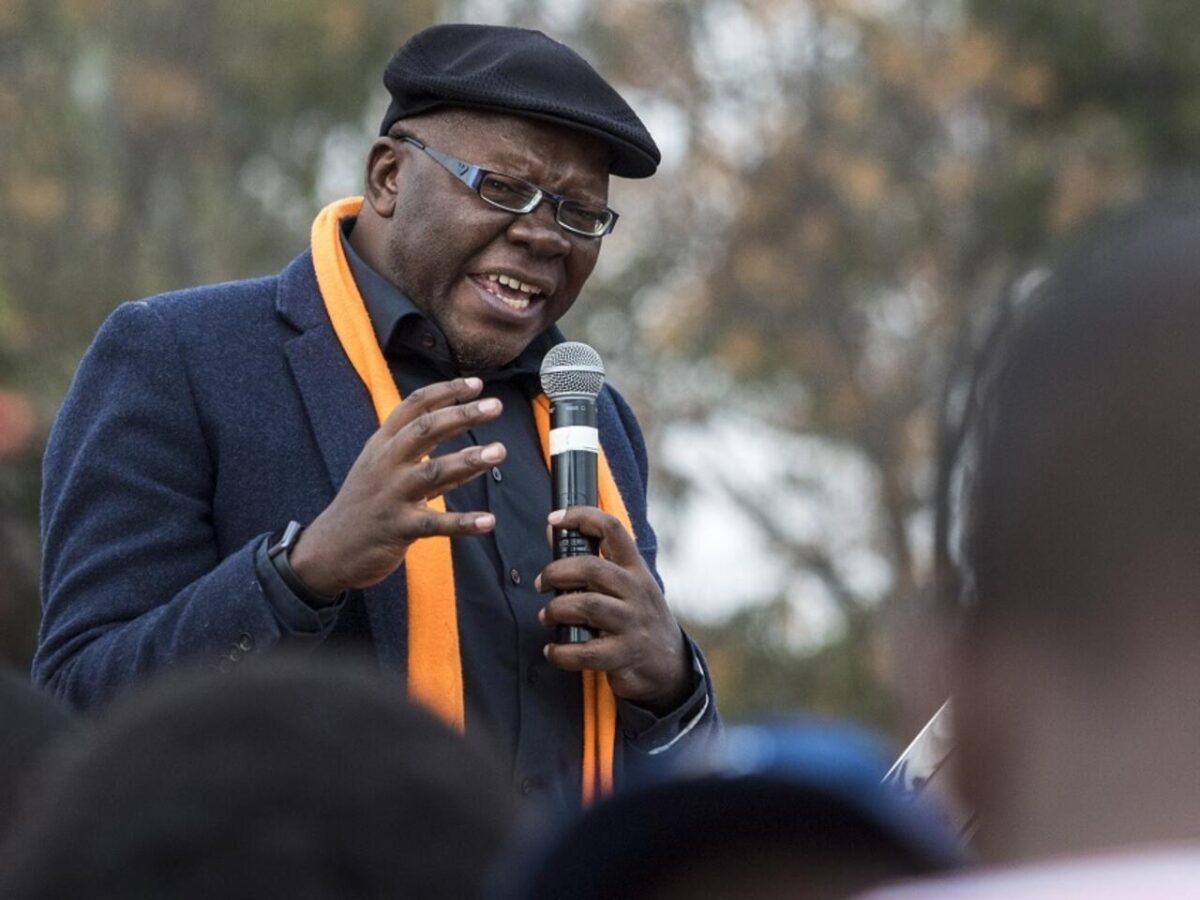
 Reboot … Tendai Biti seen at a rally in Harare on August 17, 2017 (AFP PHOTO / Jekesai NJIKIZANA)
ONE of the biggest achievements of the 2013 national constitution was the adoption of the fundamental principle of devolution and decentralisation as a central pillar of that constitution.
For decades, Zimbabwe, like most dominated social formations, had endured the legacy of a dual-enclave economy characterised by uneven and unequal development.
The dual-enclave economy was a colonial creation in respect of which a relatively developed urban white enclave existed alongside a huge black abyss of underdevelopment and subjugation.
The post-independence State failed to dismantle the dual enclave. It, in fact, deepened and consolidated the divide and inequality.
Political instability, tribalism, capture and corruption became the key drivers of post-colonial disequilibrium.
In the case of Zimbabwe, the break-up of the Patriotic Front into the splintered status quo of Zanu and ZAPU spelt danger to any region or area perceived to be supporting ZAPU.
Gukurahundi was physical genocide in respect of which Zanu North descended on the South, perceived to be ZAPU, and unleashed barbaric pain and death which the country will never recover from.
But Gukurahundi became a systematic tool of underdevelopment and deindustrialisation.
Before Gukurahundi, Bulawayo, for instance, was the industrial capital of Zimbabwe, housing some of the country’s prized manufacturing power base.
Thanks to Zanu and economic Gukurahundi, that industrial base was wiped out.
The net result was the creation of a region and citizens that are reified, isolated and excluded.
Zimbabweans have been made to feel like fourth-class citizens.
But the isolation and exclusion is a national polity that runs across the length and breadth of Zimbabwe.
Bar scattered pockets, rural Zimbabwe remains an undeveloped, isolated enclave trapped by poverty, desolation, fragmentation and fragility.
The narrative of fatalism is entrenched, from Dotito to Chiyendambuya, from Chiwara to Nembudziya, from Gweluchena to Filabusi.
To the deprived population, devolution was an instrument of fighting back against the toxic hegemony of control imposed by decades of Zanu PF misrule.
Devolution was easily the most popular, most universal constitutional theme during the 2009-2013 people-driven constitution-making process.
The new Constitution, in Chapter 14, set devolution structures in the form of eight provincial councils and the metropolitan provinces of Harare and Bulawayo.
The 2013 Constitution allowed all MPs, senators and councillors from a particular province to be members of that provincial council. There were to be 10 additional members elected indirectly through the proportional performance of political parties in the parliamentary election in that province.
Provincial councils were to be responsible solely for the development agenda and trajectory in that province.
That development agenda was to be financed by 5% of the Budget, which amount had to be distributed equitably amongst the provinces through a formula defined in an Act of Parliament.
Sixteen years after the passage of the 2013 Constitution, the Zanu PF government has deliberately failed to enact the necessary laws to actualise devolution as demanded by Chapters 14 and 17 of the Constitution.
Consequently, no provincial councils have ever been established. No devolution provincial government has ever been set up as set out in Chapter 14 of the Constitution.
The Zanu PF governments under Mugabe and Mnangagwa have killed devolution through cynical non-implementation.
Zanu was never interested in devolution. It vehemently resisted the same during the 2010-13 constitution-making process. On 18 February 2013, MDC negotiators walked out of the constitution-making dialogue after Zanu had begun reneging on devolution. It took the intervention of Mugabe and Tsvangirai to reinstate devolution and the dialogue.
Zanu PF, therefore, has always regarded devolution as an imposition that threatened its absolute hegemony and control.
Right from the word go, Zanu PF treated with disdain the 2013 Constitution and its progressive provisions on devolution, citizenship and the Bill of Rights.
The truth is Zanu PF regarded the 2013 Constitution as a forced marriage. It had no choice but to agree to the same, given its own weakness born of its 2008 election loss and the strength of the Tsvangirai-led opposition.
By 2023, it had muzzled the opposition, bought off its leadership and contrived a dubious majority vote in Parliament.
Through CAB 3, it discarded the 2013 Constitution and, in the process, plunged Zimbabwe into the realms of a new crisis of illegitimacy.
However, whereas Mugabe’s Zanu opposed devolution purely from a power point of view, the Mnangagwa regime has flipped the coin and commodified devolution.
The centre of gravity of this regime is corruption and looting. It is wired for rent and extraction.
It has created commanding heights of looting that include fuel, asset stripping, Command Agriculture, foreign currency and access to the US dollar, government contracts and procurement, commodities, subsidies and land deals.
The Mutapa Fund has become a critical instrument of theft and corruption. Its payment of US$1.9 billion to acquire a 35% stake in Kuvimba represents a grand heist that makes Cecil John Rhodes and Thomas Meikles look like amateurs.
Treasury has become the centre of massive looting, with millions of dollars paid out to dubious fat characters, mistresses and children’s mistresses.
But these are things the World Bank and IMF will never talk about.
These are issues not discussed at the stained tables of the Structured Dialogue Platform on Debt.
Regrettably, devolution funds have become a major slush fund in respect of which public resources are looted in broad daylight.
Despite the fact that devolution structures have not been established, and despite the fact that the necessary devolution laws that must be enacted in terms of Chapters 14 and 17 of the Constitution have not been enacted, the cantankerous regime has disbursed US$2.796 billion since 2019.
The following devolution funds have been disbursed:
| Year | Amount (US$m) |
| 2019 | 310 |
| 2020 | 350 |
| 2021 | 300 |
| 2022 | 300 |
| 2023 | 210 |
| 2024 | 300 |
| 2025 | 508 |
| 2026 | 518 |
| Total | 2,796 |
(Source: Ministry of Finance Budget Statements)
But they have nothing to show for these funds except the occasional clinic, mansions in Shawasha Hills, apartments in Dubai, Lamborghinis, drunken orgies and lavish weddings.
Devolution funds are disbursed through the Office of the President and Cabinet.
The Mid-Term Review Statement of 30 July 2026 disclosed that by mid-term, the OPC had received ZiG17.18 billion, representing an over-disbursement of 143%.
In other words, by May 2026, the President’s office had received Treasury disbursements of US$641 million, representing 7% of the Budget.
Devolution funds are being used to fund corrupt, unsustainable contracts. The most notorious of these is the Georgnix Geo Pomona Waste Management contract, which in its original form was costing taxpayers US$7 million a month. Now Geo Pomona is collecting all litter in Harare, and soon it will be the whole country.
Devolution funds should simply be called the Dealish Nguvava Lunch Box.
This is why they want 2030.
This is why they want to create a Munhumutapa Dynasty.
This is why they want to rule forever.
But they can’t succeed. They can’t get away with it, and that is just fact.
The truth is this regime has failed.
It must withdraw CAB 3 as a matter of urgency.
It must create a soft landing for Zimbabwe.
It must lay the foundations of a National Transitional Authority until such time as the 2013 Constitution is restored.
It’s that simple.
Zikomo, zikomo.
Tendai Biti was Zimbabwe’s finance minister from 2009 to 2013