


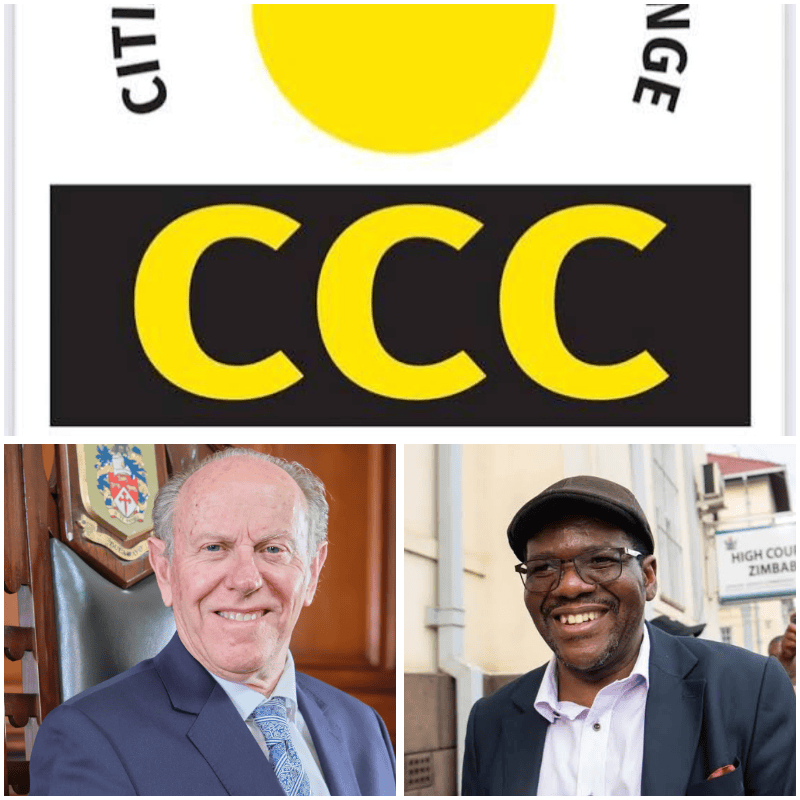
The letters, reportedly issued by Mbuso Siso, who claims to be the party’s interim treasurer-general, name Coltart, Bulawayo Central legislator Surrender Kapoikulu, Epworth North MP Togarepi Zivai Mhetu and Mbizo MP Corban Madzivanyika.
CCC interim national spokesperson Nqobizitha Mlilo, representing the Tshabangu-led leadership, said the purported recalls had no factual, political or legal basis and did not reflect the party’s position.
“The Citizens Coalition for Change (CCC) has noted with concern correspondence currently circulating in the public domain and seemingly delivered to the Speaker of the National Assembly, Advocate Jacob Mudenda; the President of the Senate, Hon. Mabel Chinomona; and the Minister of Local Government and Public Works, Honourable Daniel Garwe, MP. The correspondence purports to execute recalls of certain named public representatives,” Mlilo said in a statement issued on Friday,.
“We wish to state that these purported recalls have no factual, political, or legal basis. They do not represent the position of the Citizens Coalition for Change.”
Coltart, when initially contacted for comment, said he had seen the document but could not confirm its authenticity.
“I have seen it but have no idea whether it is legitimate,” he said, adding that he had not received any official communication from the party.
“I don’t know. I haven’t received anything official,” Coltart said when asked whether the party had communicated the recall to him.
The developments raise questions over who has the authority to initiate recalls in the CCC, which has been embroiled in internal leadership disputes and competing claims over its structures.
Mlilo said the party’s current priorities were reconstruction, institutional renewal and consolidation, arguing recalls were not a preferred tool for managing political disagreements.
“We have consistently maintained that our current trajectory is defined by party reconstruction, institutional renewal, and structural consolidation. Recalls of elected public representatives are not a political weapon of choice for this leadership,” he said.
He noted the party’s governance framework was anchored on consensus-building, institutional cohesion and stability.
The statement also accused unnamed individuals of attempting to use recalls to pressure elected officials into declaring allegiance to particular actors within the party.
“Preliminary internal investigations have identified specific individuals as behind this correspondence. The malicious intent of these actors is their long-standing aim at deploying recalls as a tool of extortion and coercion to force false allegiance from elected officials,” Mlilo said.
“Failing to secure such compliance from public representatives, their ultimate objective is to destabilise the party from within through nefarious rumour-mongering and divisive, argumentative behaviour.”
These allegations were made by the Tshabangu-led leadership, which did not name the individuals it said had been identified in its preliminary investigations.
Mlilo further said the conduct could amount to contempt of court and that CCC had briefed legal counsel to advise on its response.
“The forthcoming legal counsel will inform the political and administrative measures the party will employ to permanently resolve this infraction,” he said.
The statement reassured the named public representatives that they should continue performing their duties, asserting that their tenure remained secure until at least 2030.
Siso, whose name has been linked to the correspondence, previously challenged his removal from the party by Tshabangu in an urgent application at the Bulawayo High Court in April.
Siso later withdrew the application.
The latest dispute also comes against the backdrop of tensions surrounding Bulawayo City Council’s engagement with Geo Pomona Waste Management, a company associated with businessman Dilesh Nguwaya.
The company has announced plans to expand its waste-management operations across Zimbabwe, including into areas where agreements with local authorities have been contested or remain unclear.
Questions have emerged as to whether disagreements over the company’s