


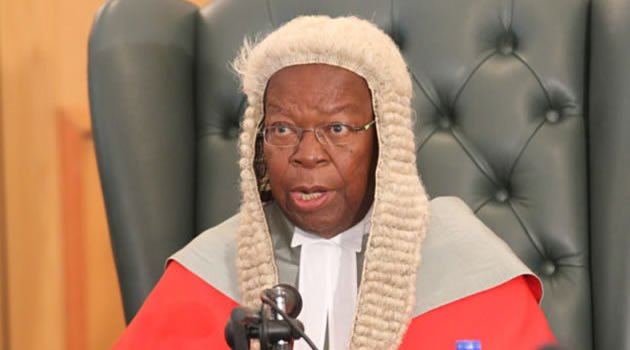
Chief Justice Godfrey Chidyausiku
Chief Justice Godfrey Chidyausiku said prosecutors were using section 121(3) of the Criminal Procedure and Evidence (CP&E) Act that allowed the state to immediately oppose bail for “sadistic†purposes.
The section allowed the state to revoke bail for seven days while it appealed against the granting of temporary freedom to suspects but prosecution often failed to do that.
Human rights defenders have in the past argued that the CP&E provision unnecessarily denied suspects their right to freedom.
They insisted that state prosecutors were taking advantage of the law to fix especially political enemies of the Zanu (PF) government by keeping them in jail.
MDC-T came out in full support of the Constitutional Court ruling.
In a statement, MDC-T information secretary, Obert Gutu described the provision as draconian.
“Many people will remember the draconian provisions of Section 121 (3) of the Criminal Procedure and Evidence Act since it was routinely abused and misused by the State in revoking bail in circumstances where an accused person would have been admitted to bail by a magistrate,†said Gutu.
“Over the years, several MDC activists were victims of this draconian law in that the public prosecutor, particularly in politically sensitive cases, would simply invoke this provision in order to make sure that accused MDC activists will be remanded in custody for a further seven (7) days regardless of the fact that the magistrates’ court would have granted them bail pending trial,†he added.
More often than not, he said, the state would not even proceed to note the said appeal “but the net effect of this notorious practice was that accused persons would have stayed in remand prison for a further seven (7) days notwithstanding the fact that they would have been granted bail.â€
Many critics of government have fallen victim to the law and prosecutors would ask magistrates to revoke bail out of routine and without solid justification.
In May last year, the state invoked the infamous section against a Harare businessman, Genius Kadungure, who was facing R1.5 million fraud charges for allegedly swindling a Zanu (PF) MP for Chegutu West, Dexter Nduna.
He was granted $1,500 bail but the prosecutor, Michael Reza, invoked then law saying the state was not happy with the court’s decision to grant Kadungure bail.
Kadungure’s lawyer, Jonathan Samukange, insisted that the invocation was an infringement on his client’s constitutional right of freedom of movement.
Section 50 (1) (d) of the Constitution says arrested persons are entitled to bail ‘unless there are compelling reasons justifying their continued detention.
“The MDC would like to express its deep pleasure and joy at this ground- breaking ruling by the Constitutional Court of Zimbabwe.
“We would also like to take this opportunity to heartily congratulate the legal team of Mandevere Marufu and Kudzayi Kadzere who argued the case on behalf of the applicants in the highest court of the land,†said Gutu.
He congratulated the entire staff at the Zimbabwe Lawyers for Human Rights (ZLHR) for their “sterling and determined effort to fight for human rights in Zimbabwe.â€
Gutu, a lawyer by profession, urged the speedy harmonisation of about 400 pieces of legislation with the constitution that was adopted in 2013.
“The people of Zimbabwe deserve to enjoy all the fundamental human rights that are guaranteed in terms of Chapter 4 of the Constitution of Zimbabwe,†said Gutu.
Post published in: Featured