


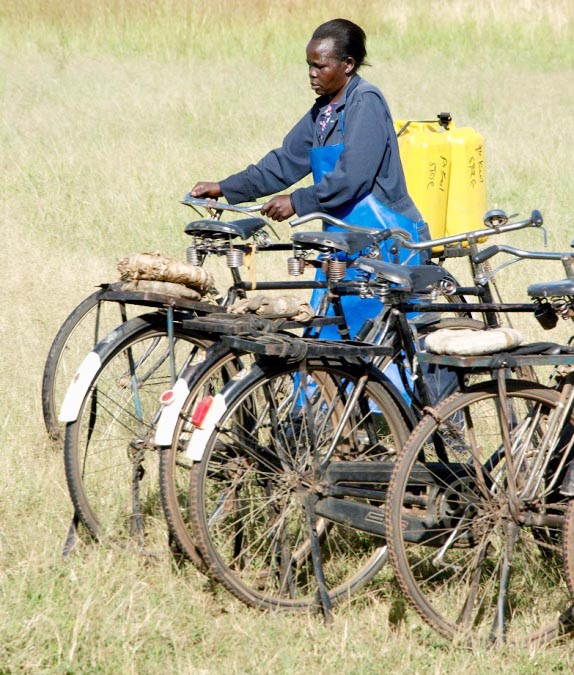
Woman prepares to travel to neighbouring communities for IRS
Where are we going wrong in effectively reducing mortality for this preventable and treatable disease?
It should be noted, that malaria mortality rates have in fact decreased in recent years. Significant efforts have been made by governments, non-profit organisations (NGOs) and the private sector alike, to continue reducing the impact of malaria in Africa by scaling up on intervention methods.
Despite this decrease, Malaria is still the number one cause of hospitalisations and deaths in Africa. In fact, malaria causes more deaths than HIV and tuberculosis, considering that there is a malaria related death every 30 seconds in Africa, predominantly among women and children.
Despite increased initiatives to combat Malaria, the challenge is that there continues to be major gaps in intervention coverage. Further, 278 million of the 840 million people at risk of malaria in sub-Saharan Africa live in households that do not have a single insecticide treated mosquito net and, between 56 and 69 million children with malaria do not receive anti-malarial drugs. Another factor working against malaria prevention efforts, is the high rate of insecticide resistance in a number of countries.
In the fight for malaria, various stakeholders are involved however there seem to be a silo approach. What has been your company’s experience?
We have been able to work with a variety of stakeholders across sub-Saharan Africa that are both in the public and private sector including NGO’s and donors. This multi-stakeholder approached to malaria prevention has proven beneficial in the countries within which we have worked with these partners.
For example, as a member of Roll Back Malaria and the Global Business Coalition for Health (GBCHealth), we are able to engage with a number of stakeholders to ensure alignment across the board. In addition, we are actively working to foster our ongoing partnerships with the Malaria Consortium, USAID, WHO and various Health Ministries within the SADC, including most recently, the Mpumalanga Government and the NICD Sandringham – to name a few, on pro-active preventative and effective intervention initiatives that will help combat the endemic. Furthermore, a successful Indoor Residual Spray (IRS) program for e.g. is a factor of effective collaboration between the public and private sectors.
We have witnessed that the combined efforts of the private sector and the governments of SADC are registering positive impact of IRS on fighting malaria.
If various interventions are in place, what is the main challenge in ensuring we reduce death rate as result of malaria to zero?
Following from the response to question 1, the challenge is that there continues to be major gaps in intervention coverage. 278 million of the 840 million people at risk of malaria in sub-Saharan Africa live in households that do not have a single insecticide treated mosquito net and, between 56 and 69 million children with malaria do not receive anti-malarial drugs.
Prevention has proven to be the best form of intervention in the case of malaria, with the two most successful methods found in insecticide-treated mosquito nets and insecticides that are used to spray in-and-around houses (indoor residual spraying). While a number of products are available, the quality and durability of nets aren’t all the same and overtime mosquitoes have built up resistance to certain chemical classes used in developing insecticides.
What is the contribution being made by your company and the motive behind your drive?
Bayer is committed to our mission of “Science for a Better Life†and has been a long time player in the fight against Malaria. In several African countries, such as Ethiopia, Uganda, Zambia and Malawi, Bayer has actively participated for many years in the fight against malaria, which is transmitted by the Anopheles mosquito. As Bayer, the eradication of the disease would come as good news given the research and innovation that has gone into this. We would happy to be recognised as one of the stakeholders that helped in the fight to end fatal effects of malaria.
Bayer has further committed itself to Malaria prevention, through innovation. To this end, we have increased our investment in Research and Development ten-fold in the last five years alone. Further, because our products are manufactured in South Africa for Africa, we have a solid understanding of the African environment that enables us to continue innovating products and solutions and demonstrate our commitment to business in Africa.
What economic, social and even physical efforts is your company making to ensure you cover most communities whilst meeting the needs of vulnerable demographic groups especially children and what current challenges are you ?
Bayer is part of community mobilisation in the areas in which we work. This means that we provide training, marketing and communication to the Public Health Officer and communities to ensure the success of malaria prevention campaigns. We also ensure Anti Packaging Management through the incineration of all our packaging to reduce any potential risks. In our IRS programme, we however face a lot more challenges.
We currently experience a high turnover on the people available due to the toxic nature of the insecticides and the weight they have to carry. It is also very important to note, that in order for an IRS campaign to be successful, there needs to be a well-co-ordinated community approach/implementation that requires tight logistics because the isolated or singular use of mosquito nets does little to combat malaria in a given area.
Post published in: Featured