


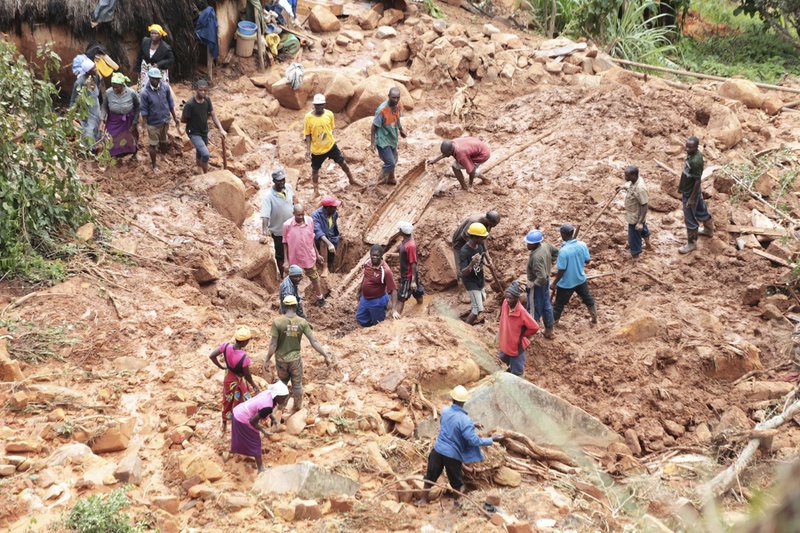
A family dig for their son who got buried in the mud when Cyclone Idai struck in Chimanimani about 600 kilometres south east of Harare, Zimbabwe, Tuesday, March, 19, 2019. AP Photo/Tsvangirayi Mukwazhi)
Introduction
The Network for Environmental and Climate Justice (NECJ) has noted pronouncements to the effect that a total of 279 individuals reported missing since Cyclone Idai hit Chimanimani district in Zimbabwe’s Manicaland Province in 2019 will be delared dead.
This follows an order being sought at the Mutare High Court by the Attorney General, Mrs Virginia Mabiza who has mounted a class action on behalf of families of the missing persons.
The move is part of efforts to bring closure on the issue of the missing persons and NECJ prays for healing to the affected families.
When Cyclone Idai hit Chimanimani district in 2019, an estimated 340 people lost their lives while 279 were reported missing up to date.
This statement has a special focus on Chimanimani district but it is worth noting that the recommendations captured here apply at the national level as well.
Post Cyclone Idai in Chimanimani
It is essential to note that effects of climate change such as flooding impact on a number of internationally guaranteed human rights, including the rights to life, right to self determination,development, food, health, water and sanitation and
housing and Chimanimani suffered these adverse effects when Cyclone Idai hit the area.
Agricultural productivity was affected while a number of villagers became environmental refugees.
In its interactions with the Chimanimani community, NECJ established that the devastating effects of Cyclone Idai in Chimanimani lead to mental health problems as villagers continue to struggle to put their sad and horrible past behind them.
These environmental and health consequences threaten civil and political rights as well as economic, social, and cultural rights that include rights to life, access to safe food and water, health, security, shelter, and culture.
Disasters associated with climate change often increase social inequalities while crippling social justice and this is the case of Chimannimani post Cyclone Idai.
In Chimanimani, as is the case in all areas of Zimbabwe and globally, climate change and its associated disasters has negatively affected sustainable development.
Towards Climate Justice in Chimanimani
It is critical to note that climate justice programmes should recognise that Cyclone Idai in Chimanimani lead to a multitude of detrimental social, economic, and health impacts on vulnerable communities while perpetuating and magnifying structural inequalities between women and men.
Climate change disasters continue to pose threats to ways of life, livelihoods, health, safety and security for women and girls in Chimanimani district.
Therefore, it is essential to note that efforts to mitigate and adapt to climate change should conform to human rights norms and principles.
These include the rights to participation and information, transparency, accountability, equity, and non-discrimination.
The human rights framework must be part of efforts towards Climate Justice in Chimanimani.
Affected individuals and communities must be afforded the opportunity to
participate, without discrimination, in the design and implementation of climate justice programmes.
NECJ recommendations
*Part of these recommendations are based on United Nations Office for
Coordination of Humanitarian Affairs recommendations on climate change mitigation and adaptation*
- It is critical for the Government of Zimbabwe and other Development Partners to consider the following;
- To respect, protect, fulfill and promote all human rights for all affected persons without discrimination.
- To ensure that affected communities have the necessary capacity to adapt to climate change- particularly those that are most vulnerable. There is need to devote resources towards the realization of social, economic and cultural rights of these.
- To mobilize maximum available resources for realization of economic, social and cultural rights, as well as for the advancement of civil and political rights and the right to development – international cooperation is key in this regard.
- Post Cyclone Idai there is need to promote equity by ensuring that efforts to mitigate and adapt to the impacts of climate change should benefit people in vulnerable situations and future generations.
- Addressing inequalities Post Cyclone Idai is key and efforts to address climate change should ensure gender equality, promote and protect the rights of children, older persons and others in vulnerable situations.
- There is need to ensure meaningful and informed participation on climate change and its related disasters by the Chimanimani community and the government must make early-warning
information regarding climate effects and natural disasters available to all sectors of the society. Adaptation and mitigation plans should be publicly available, transparently financed and developed in consultation with the affected community. This is in line with the concept of community solutions to community problems.
- Strengthening disaster preparedness and management is key and in this regard, devolution of resources- (both financial and human) is essential to allow for area centered responses.
- Govt must mainstream climate change in all its policies and work with civil society organisations, traditional leaders and local communities to raise awareness. It is critical to put human rights and social justice at the core of efforts to address climate change and its related disasters.
- Govt and other duty bearers must recognise the role of traditional leaders in climate change adaptation and mitigation as well as information dissemination.
- Restoration of livelihoods and regular counselling sessions for affected families is equally important.
Post published in: Featured