


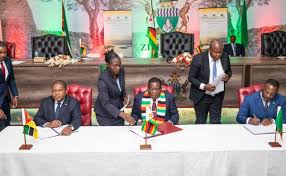
Harare, 19 Jul (AIM) – Mozambique, Zimbabwe and Zambia signed, on Thursday, in Harare, a Transfrontier Conservation Agreement (ZIMOZA-TFCA), which aims at promoting biodiversity conservation, ecosystem restoration and sustainable management of the natural resources that the three countries share.
The agreement was signed by Mozambican President Filipe Nyusi, his Zimbabwean counterpart, Emmerson Mnangagwa, and the Zambian minister of tourism, Rodney Sikumba.
The cross-border area in question covers 38,435 square kilometers, along the Zambezi River. In Mozambique, it covers the districts of Mágoè, Cahora Bassa and Zumbo, in the central province of Tete. In Zimbabwe, two districts are covered, Mbire and Makonde, and in Zambia, only the Luangwa district is covered.
Speaking at the ceremony, Nyusi said that the tripartite ZIMOZA-TFCA initiative also aims to effectively conserve the environment and promote the natural resources “that our ancestors bequeathed to us.”
“This agreement is a milestone in the history of our three countries and is in line with the Southern African Development Community (SADC) Development Goals and the principles set out by the United Nations on the sustainable promotion of the environment”, Nyusi said.
The conservation of biodiversity and its mineral resources, he said, requires efforts from all sectors, and there is a need for civil society and governments to work together to restore nature.
For his part, Mnangagwa said that the agreement represents a new era in the cooperative relations between the three countries, as it fulfils one of the objectives of the African Union’s agenda on promoting the environment.
“This agreement will promote the conservation of our resources, opening up space for the creation of mechanisms to preserve the region’s wildlife resources”, he said.
The Zambian minister, speaking on behalf of President Hakainde Hichilema, said that Africa had realized the need to conserve its precious areas.
“This agreement is historic because it represents our unity in preserving the environment. It’s a good strategy because it helps our people work to conserve the environment and wildlife”, he said.
The tripartite initiative, which will be coordinated by Zimbabwe over the next two years, directly affects around 600,000 people living in the cross-border area. For their survival, most of these people depend heavily on the resources of this region, mainly water, fish, wildlife and forests.
(AIM)
Ad/pf (379)
84724E CAD WILL APPEAL TO CONSTITUTIONAL COUNCIL
Maputo, 19 Jul (AIM) – The Democratic Alliance Coalition (CAD) announced in Maputo on Thursday that it will appeal to the Constitutional Council, Mozambique’s highest body in matters of constitutional and electoral law, against the decision by the National Elections Commission (CNE) barring it from participating in the parliamentary and provincial elections scheduled for 9 October.
The CNE based its decision on the CAD’s failure to comply with the law on political parties. That law allows political parties to form coalitions, but they must notify the Ministry of Justice (the state body in charge of registering parties) of any changes in their composition.
The original CAD coalition pact dates from 2018, but a new pact was signed by the six constituent parties of CAD on 27 April. CAD should have informed the Justice Ministry within 15 days – but it did not inform the Ministry until 28 June, which was about six weeks too late.
CNE spokesperson Paulo Cuinica claimed that informing the Ministry of Justice of any changes to the pact was “an essential requirement”. Failure to notify the Ministry meant that the CAD lists of candidates for the elections were automatically invalid.
An obvious problem with this approach is that the CAD nomination papers have been with the CNE for months, but it was only on Thursday that the CNE declared them invalid.
Cuinica could give no explanation for the delay. The fact that the CAD of 2024 was using a different convention pact from the CAD of 2018, should have been obvious – and there was enough time for the CNE to notify CAD of the irregularity and ask for a correction.
It chose not to do so, and Cuinica made the remarkable claim that invalidities “can be invoked at any time”, even after the election. If this claim were to be taken seriously, anybody could claim that an election is invalid, even after all the votes have been counted and the result declared.
Fortunately, the alternative explanation, that Cuinica did not know what he was talking about, is much more likely.
The CAD is backing the independent candidate in presidential election, Venancio Mondlane, who was once a senior figure in the main opposition party, Renamo.
Immediately after the CNE rejected the CAD lists of candidates, Mondlane declared “we shall appeal to the Constitutional Council”, and he was confident that the Council will find in CAD’s favour.
“We shall use all windows and opportunities to prove that our rights have been violated”, he declared. “We had already foreseen that some CNE members wanted to reject our candidates, but we are calm”.
He claimed that the CNE does not have the power to declare any election candidacy invalid, and it had never done so in previous elections. This is a point of law which the Constitutional Council will have to decide.
“The CNE decision is not legal – it is political and partisan, unfounded and unfortunate”, he accused.
Mondlane called for the current CNE to be dismantled, and replaced by a truly independent CNE.
That would require sweeping changes to the electoral law, which enshrines political party control over the 17 member CNE. Even the CNE members who supposedly come from civil society are, in reality, filtered through the political parties. The result is a Commission dominated by the ruling Frelimo Party, but on which the opposition is guaranteed seats.
For years, election observation groups have called for the political parties to be removed from the CNE, but none of the parties will accept this.
CNE members “represent the parties and not the people”, said Mondlane. “The CNE should reflect the population, and we need a more representative model”.
Mondlane was speaking shortly after returning from a tour of the northern provinces, where he claimed his presidential bid was enthusiastically welcomed.
“In Nampula our reception was phenomenal”, he said. “In Cabo Delgado, our rallies were very crowded. In Niassa, we met some intolerance from our adversaries, and we understood that even the police have been politicized. This is something that CAD is going to change”.
Mondlane lamented the governance of the past ten years, under President Filipe Nyusi, noting that the percentage of Mozambicans living below the poverty line has risen from 48 to 63 per cent. It is hard to argue with these figures, since they come from government documents.
(AIM)
Pf/ (718)
85724E SUGAR DISTRIBUTOR CHARGED WITH MONEY LAUNDERING, DRUG TRAFFICKING
Maputo, 19 Jul (AIM) – Mozambique’s Central Office for the fight against Organised and Transnational Crime has accused the man responsible for most distribution of sugar in the country of money laundering, tax fraud, falsification of documents and the use of forged documents, drug trafficking, financing of terrorism, abuse of trust and criminal conspiracy.
According to a report in Friday’s issue of the independent newsheet “Mediafax”, this man, Ismael Hagi Noor Mahomed, owns the company Auto-Pac Ltd, which has a monopoly on packaging and distributing sugar for the Mozambican market.
It is thus a key partner of the National Sugar Distributor (DNA). All the sugar produced by Mozambique’s four functioning sugar mills, represented by the DNA, is delivered to Auto-Pac for packaging and distribution.
Auto-Pac has its headquarters in the southern city of Matola and was set up in 2007.
Noor Mahomed owns a further three companies which are also under investigation for the same range of crimes, including money laundering and drug trafficking. They are Lifepack Ltd, the tourist resort Together in Palma lodge, both located in Palma district, in Cabo Delgado province, which is one of the areas seriously hit by islamist terrorism, and Creative SU, Ltd.
The premises of all of these companies have been searched and material seized from them. A Maputo judge, Eusebio Lucas, has ordered their bank accounts frozen.
Noor Mahomed is on a list of 39 business people who through 48 shell companies, and with the help of corrupt customs officials and bank managers is alleged to have forged documents and simulated imports of merchandise which, in reality, never entered the country. The Attorney-General’s Office (PGR) says that the frauds committed by these companies have damaged the Mozambican state to the tune of 800 million US dollars.
Noor Mahomed seems unlikely to stand trial for his crimes. According to “Mediafax”, he and his family have fled to Dubai.
Filipe Raposo, the executive director of the DNA, admitted that he is deeply concerned by the accusations against Noor Mahomed, given the importance of Auto-Pac for sugar distribution. Since Auto-Pac’s bank accounts are frozen, it is unable to meet its obligations to the DNA.
Raposo hoped the investigations will be rapid, in order to minimize any damage to sugar distribution.
(AIM)
Pf/ (383)
86724E HIDDEN DEBTS: CHANG TRIAL UNDER WAY IN NEW YORK
Maputo, 19 Jul (AIM) – United States prosecutors on Tuesday accused former Mozambican finance minister, Manuel Chang, of taking seven million dollars in bribes from the Abu Dhabi based group, Privinvest.
The bribes were part of the scandal that has come to be known as the “hidden debts”. In 2013 and 2014, three fraudulent, security-related Mozambican state companies, Proindicus, Ematum (Mozambique Tuna Company) and MAM (Mozambique Asset Management) obtained loans of over two billion dollars from the banks Credit Suisse and VTB of Russia.
The banks granted the loans even though all three companies were run by the Mozambican intelligence service, SISE, and had no business record at all. The loans were only possible because the government of the time, under the then President, Armando Guebuza, issued guarantees for 100 per cent of the loans.
The guarantees were signed by Manuel Chang, who must have known they were illegal since they smashed through the ceiling on guarantees set by the budget laws of 2013 and 2014. Since it was Chang himself who steered those laws through the Mozambican parliament, the Assembly of the Republic, he certainly knew that the loans were illicit.
Predictably, the three companies could not repay the loans and soon went bankrupt, leaving the Mozambican state liable for the full amount. Thus hidden loans became hidden debts.
But the loans had been syndicated and had been sold on to other investors, including American investors. This led the US Justice Department to take an interest. It drew up indictments against Mozambican and Privinvest fraudsters, including Chang.
Chang had no idea he was under investigation until he was detained at Johannesburg airport in December 2018, while in transit to Dubai. The South African police acted on the basis of an international arrest warrant issued by the US prosecutors. Chang found himself charged with conspiracy to commit money laundering, wire fraud and securities fraud.
Both the US and Mozambique wanted Chang, but the US extradition request arrived first. For years legal battles raged in South African courts as to whether Chang should be sent to Maputo or to New York. Eventually the American case prevailed, and Chang was sent to New York, where he has been awaiting trial since July of last year.
At the opening of the trial, according to the Law 360 portal, cited by the Portuguese news agency Lusa, a prosecutor, Peter Cooch, told the jury that Chang was “a corrupt foreign functionary who abused his authority to enrich himself through bribes, fraud and money laundering”.
Cooch accused Chang of conspiring to divert funds that had initially been intended for Mozambican coastal protection and fishing. Those who invested in Proindicus, Ematum or MAM lost millions of dollars because the companies all failed and Mozambique could not repay the loans.
Cooch said that Privinvest officials consciously agreed to a corrupt deal, under which Chang would sign off on the guarantees for massive contracts, but at a price.
The prosecution evidence, he added, would include documentation on the Privinvest bribes and electronic transfers to a Swiss bank account controlled by a friend of Chang.
“The accused was so careful that he tried to avoid leaving a paper trail”, said Cooch. “But his co-conspirators were not so careful and documented their crimes”.
Chang’s lawyers told the jury that the prosecution has no evidence that Chang received “a single cent” from the seven million dollars allegedly paid in bribes.
They blamed the investors for losing their money and not the fraudsters who had stolen it. “That’s what happens when risky investments are made in emerging markets”, claimed lawyer Adam Ford.
(AIM)
Pf/ (606)
87724E PM URGES JUDGES NOT TO GO ON STRIKE
Maputo, 19 Jul (AIM) – Mozambican Prime Minister Adriano Maleiane on Thursday urged the country’s judges and prosecutors not to go on strike.
The Mozambican Association of Judges (AMJ) has warned that its members will begin a 30 day strike on 9 August, claiming that the government has shown no willingness to solve the problems faced by judges.
It claims that the interests of judges were seriously damaged by implementation of the Single Wages Table (TSU) in the public administration as from 2022. The AMJ regarded the TSU as a wage cut.
The judges are also demanding the financial independence of the judiciary. The AMJ wanted to see the courts and the Attorney-General’s Office to become independent of the government.
Speaking to reporters on Thursday, Maleiane said the government is discussing the demands made by the judges and prosecutors and he could see no reason for them to take strike action.
He recognized the legitimacy of some of the concerns they had raised, and said the government had set up “dialogue teams”. Two key points had been identified – one was wages, and the other was “questions of clarification about what is going on”.
“The message I am leaving is that there is no need for a strike”, Maleiane declared. The questions raised by judges and prosecutor “have solutions, and we are working within the structure we have set up, and which is functioning very well”.
The Prime Minister was optimistic that the matters brought to the negotiating table could soon be answered, and so he asked for calm.
“I hope things happen as quickly as possible”, he stressed. “Right now, we are at a very advanced stage, and I just ask all judges and magistrates to keep calm”.
(AIM)
Pf/ (296)
Post published in: Featured