Is Zimbabwe’s political crisis likely to escalate?
Tensions inside Zimbabwe's ruling party have the potential to destabilize the southern African country. Analysts warn civil war could follow if party infighting is not resolved.
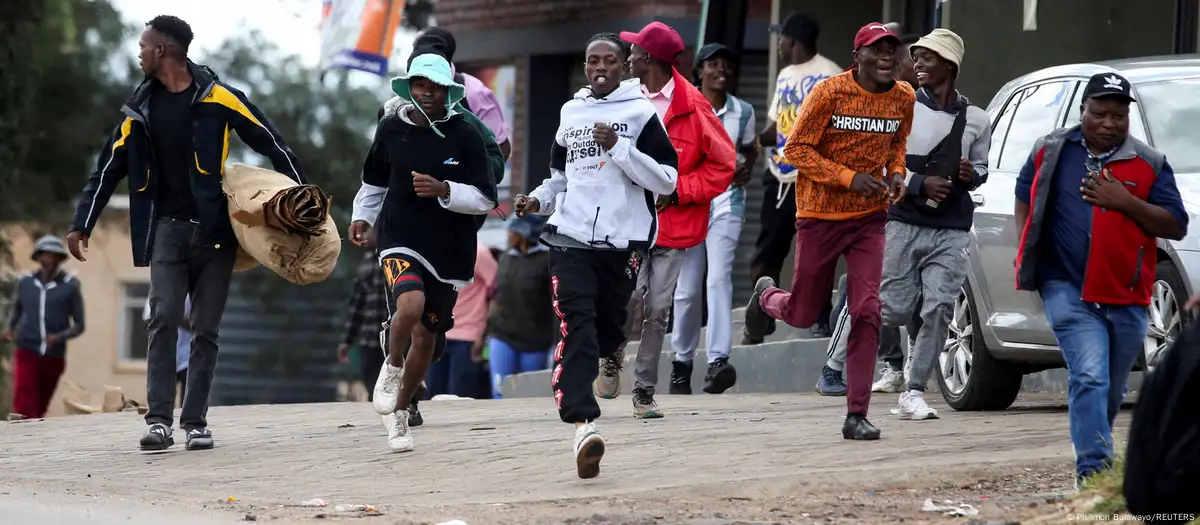
Small groups of protesters gathered under heavy security in Harare on MondayImage: Philimon Bulawayo/REUTERS
Zimbabwe has been experiencing political instability in the last month. A faction of the ruling Zimbabwe African National Union Patriotic Front (ZANU-PF) party has called for the the resignation of President Emmerson Mnangagwa in light of a reported plan that he would extend his final term after its official end in 2028.
Blessed Geza, a veteran of the 1970s war of liberation and former senior member of Mnangagwa’s ZANU-PF party, has been leading the verbal attack on the president and called for country-wide protests to take place on Monday.
Yet when the big day came around, the streets were largely silent, with only small groups gathering amidst heavy police presence. Most citizens opted to stay at home and avoid potential chaos. Despite the low turnout, Geza has continued to urge Zimbabweans “not to be cowards” in his posts on X.
Accusations against Mnangagwa
The former war veteran insists that Mnangagwa should step down before the country’s independence celebrations on the April 18. Emmerson Mnangagwa is currently serving his second and presumably final term as head of ZANU-PF party, which has ruled Zimbabwe since the country’s independence from Britain in 1980. Mnangagwa became president in 2017, following a coup that overthrew longtime leader Robert Mugabe. In January, ZANU-PF party leaders passed a resolution that Mnangagwa should seek a third term via a constitutional amendment. He has assured the public that he will retire when his term ends in 2028, yet many remain skeptical.
Zimbabwe’s new currency struggles amid old problems
The war veterans led by Geza accuse President Mnangagwa of corruption and feel he is responsible for the failing economy. Independence war veterans are influential in Zimbabwe’s politics. They want Vice-President Constantino Chiwenga, a retired army general who was instrumental in the ousting of Mugabe, to replace Mnangagwa.
Chiwenga has not commented publicly on the calls for him to lead the country, and government officials maintain there is no rift between the two prominent party members.
Yet some analysts predict that major civil unrest could be on the way and could lead to civil war. “What we are seeing has the potential to be a national and regional security threat,” Blessing Vava, executive director of the Crisis in Zimbabwe Coalition, told DW. The coalition brings together dozens of civil society organizations to bring about democratic change in the country.
Vava added that the events were playing out as a result of tensions that have been simmering since the 2017 ousting of former president Mugabe. “President Mnangagwa has been trying to coup-proof himself by purging army generals. The military, on the other side, has a feeling that the coup hasn’t ended because one of them is not yet in office,” Vava said.
Opponants of Emmerson Mnangagwa accuse him of corruption and blame him for the country’s struggling economyImage: Tsvangirayi Mukwazh/AP Photo/picture alliance
Questionable leadership changes
President Mnangagwa has recently made leadership changes that suggest he may be concerned about losing his grip on power. He moved the head of the country’s army, Anselem Sanyatwe, to the position of sports minister. Sanyatwe is considered to be an ally of Chiwenga, since both were instrumental in the 2017 coup that brought Mnangagwa to power, ending Robert Mugabe’s 37-year rule. The president also recently removed the chief of police and head of Zimbabwe’s intelligence service.
ZANU-PF is set to hold its elective congress in 2027, where it is expected to tap Mnangagwa’s successor, who will then run for office in 2028. Chiwenga has never publicly supported the proposal to extend Mnangagwa’s term.
He is believed to have the backing of the military, although that support could be weakening as Mnangagwa removes key military figures from their posts.
Citizens should not be used as pawns
Around ninety-eight people alleged to have taken part in the March 31 protests were arrested in central Harare and appeared in court on Tuesday. They were accused of inciting public violence and breaching peace.
In videos circulating on social media on Monday, police are seen firing tear gas to disperse the small crowd that had gathered in the center of the country’s capital. In one, an elderly woman on crutches vowed to keep protesting despite heavy security. “I am 63, and life is tough. I am taking care of my grandchildren because my children cannot afford to,” she said.
Vegetable vendor Esnath Makaya knows protests are bad for businessImage: Privilege Musvanhiri/DW
But Vava of the Crisis in Zimbabwe Coalition says Zimbabweans need to be careful not to allow politicians to use them as pawns to achieve their own political goals. “The ongoing protests and factional disputes are not a fight for citizens. It is a ZANU-PF internal fight. Zimbabweans must not be fooled,” Vava told DW.
“When citizens marched in 2017 to remove Robert Mugabe, there were high hopes for change, but some officials within ZANU-PF later turned around and said the coup was only an internal dispute, not one for the general population of the country,” he added.
Economic risks
Many people who make a living on the country’s informal economy were impacted by Monday’s call for protests. The majority of businesses were shut down around the country, and many streets were empty, as business owners worried about their properties being damaged or looted.
“Protests do not give us income. We are forced to stay indoors. What are we going to eat? Protests may be good for others but not for us,” Esnath Makaya, a vegetable vendor, told DW.
Economic analysts say the increased infighting in the ruling party is heightening the country’s political risk, which will in turn negatively affect foreign investments in Zimbabwe.
“The economy will take a back seat. Development and economic issues are secondary to political tensions,” economic analyst Happiness Zengeni told DW.
“People who may have wanted to invest in Zimbabwe will exercise caution until after 2028. It just means there will be no money circulating,” Zengeni added.
We use cookies on our website to give you the most relevant experience by remembering your preferences and repeat visits. By clicking “Accept All”, you consent to the use of ALL the cookies. However, you may visit "Cookie Settings" to provide a controlled consent.
This website uses cookies to improve your experience while you navigate through the website. Out of these, the cookies that are categorized as necessary are stored on your browser as they are essential for the working of basic functionalities of the website. We also use third-party cookies that help us analyze and understand how you use this website. These cookies will be stored in your browser only with your consent. You also have the option to opt-out of these cookies. But opting out of some of these cookies may affect your browsing experience.
Necessary cookies are absolutely essential for the website to function properly. These cookies ensure basic functionalities and security features of the website, anonymously.
Cookie
Duration
Description
cookielawinfo-checkbox-analytics
11 months
This cookie is set by GDPR Cookie Consent plugin. The cookie is used to store the user consent for the cookies in the category "Analytics".
cookielawinfo-checkbox-functional
11 months
The cookie is set by GDPR cookie consent to record the user consent for the cookies in the category "Functional".
cookielawinfo-checkbox-necessary
11 months
This cookie is set by GDPR Cookie Consent plugin. The cookies is used to store the user consent for the cookies in the category "Necessary".
cookielawinfo-checkbox-others
11 months
This cookie is set by GDPR Cookie Consent plugin. The cookie is used to store the user consent for the cookies in the category "Other.
cookielawinfo-checkbox-performance
11 months
This cookie is set by GDPR Cookie Consent plugin. The cookie is used to store the user consent for the cookies in the category "Performance".
viewed_cookie_policy
11 months
The cookie is set by the GDPR Cookie Consent plugin and is used to store whether or not user has consented to the use of cookies. It does not store any personal data.
Functional cookies help to perform certain functionalities like sharing the content of the website on social media platforms, collect feedbacks, and other third-party features.
Performance cookies are used to understand and analyze the key performance indexes of the website which helps in delivering a better user experience for the visitors.
Analytical cookies are used to understand how visitors interact with the website. These cookies help provide information on metrics the number of visitors, bounce rate, traffic source, etc.
Advertisement cookies are used to provide visitors with relevant ads and marketing campaigns. These cookies track visitors across websites and collect information to provide customized ads.
When you consent, your personal data will be used for personalization of ads