


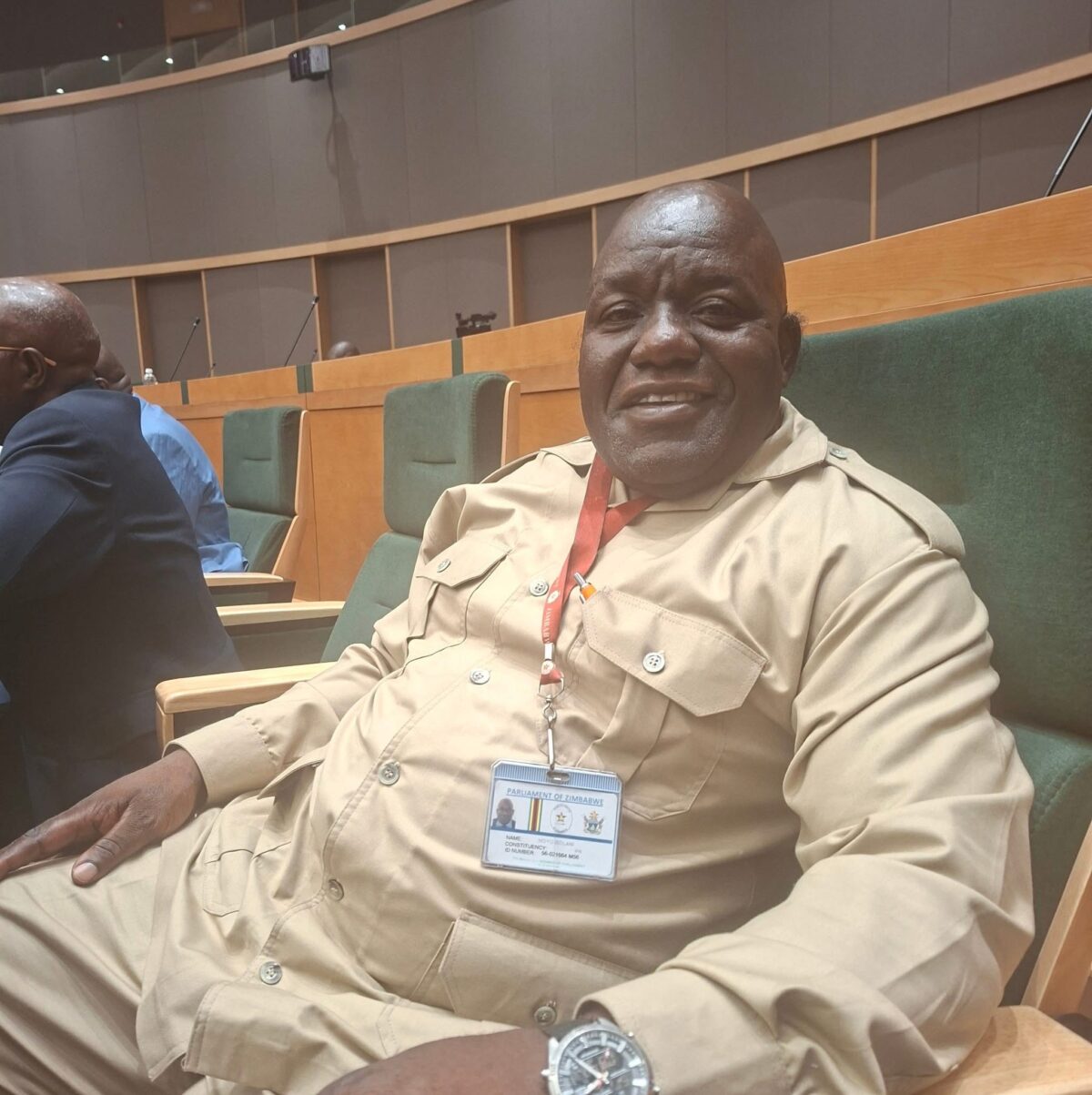
 CCC senator Solani Moyo
HARARE — Citizens Coalition for Change lawmakers were sharply divided in their contributions to Tuesday’s Senate debate on the Constitution of Zimbabwe Amendment Bill (No.3), with some delivering full-throated rejections of the proposed changes while others voiced qualified or even partial support – a split that echoes the National Assembly, where 35 CCC MPs voted with Zanu PF to pass the Bill, 42 objected and nine abstained.
The CCC has 27 representatives in the 80-member Senate which is also made up of 18 chiefs, two representatives of people with disabilities and 33 Zanu PF senators. For the Bill to pass, the government must obtain a two thirds majority – a minimum 54 votes.
CCC senators’ contributions to Tuesday’s debate, which adjourned without a vote and resumes on Wednesday, suggest the party may struggle to present a united front when the Bill eventually comes to a division in the Upper House.
Senator Solani Moyo of Matabeleland South delivered the most uncompromising speech of the sitting, describing CAB3 as “a coordinated scheme” designed to consolidate executive power, remove electoral accountability, weaken independent institutions and bypass the constitutional requirement for a referendum.
She said the Bill’s proposal to extend the terms of the President, Parliament and other elected officials from five to seven years amounted to lawmakers attempting to extend their own mandate without returning to the people.
“Let us be clear, no elected body has the authority to extend its own mandate without returning to the people,” Moyo said. “If we as parliament can extend our term once, what will stop us from doing so again and again without ever returning to the people? That cannot and must not be allowed. That is how democracies die, not in a single moment but through incremental extensions of power without accountability.”
Moyo also took aim at the clause removing direct presidential elections in favour of parliament choosing the president, the addition of ten more presidentially-appointed senators, the transfer of the voters’ roll to the Registrar General, and increased executive control over judicial appointments. She urged the Senate to reject the Bill in its entirety.
But other CCC senators were far less hostile to the Bill. Senator Linda Sibanda representing Bulawayo said she supported several of its central provisions, including the seven-year presidential term, the appointment of 10 additional senators by the president, and moving the voters’ roll to the Registrar General’s office, framing her support around the demands of Vision 2030 and the National Development Strategy.
Her objections were narrower: she wants the proposed Zimbabwe Delimitation Commission’s functions to remain with the Zimbabwe Electoral Commission, and she wants the Zimbabwe Gender Commission preserved rather than folded into the Human Rights Commission.
“I, therefore, support the Bill with amendments to retain the delimitation function under ZEC and maintain the Gender Commission. I so submit and support the Bill,” Sibanda told the House.
Senator Kudakwashe Matibiri (Manicaland), who chaired a public consultation team in Mashonaland West, told the Senate his hearings had found “widespread support” for CAB3, though he argued the Bill should still be put to a referendum to strengthen its legitimacy.
“We lose nothing in consulting the sovereign because it is in our history, it is in our DNA to do so and it will improve the integrity of this whole process,” he said, while stopping short of opposing the Bill outright.
Senator Tapfumanei Muzoda (Mashonaland West) gave a similar account, saying the Bill “was being welcomed a lot” by the people he consulted. His own reservation was narrower still – he argued voter registration should remain with the Zimbabwe Electoral Commission rather than move to the Registrar General’s office, and he, too, suggested the matter be referred back to the people rather than rejecting it on the floor of the Senate.
Senator Sesel Zvidzai, whose objections to the Bill were among the more detailed delivered by a CCC member, nonetheless prefaced his remarks by praising Mnangagwa’s economic record, telling the Senate he did not intend to criticise a leader he believed had “done much better than his predecessor” and crediting him with lifting GDP from “a measly 20 or so to 57.”
Only after that did he turn to what he described as the central question of the debate: who owns the constitution, and arguing that authority belongs to the people and not to parliament or the executive.
By contrast, traditional chiefs who addressed the Senate were overwhelmingly supportive of CAB3, with at least 10 chiefs speaking in favour during Tuesday’s sitting and none registering outright opposition.
Their sole point of consistent objection to the proposed folding of the Gender Commission into the Human Rights Commission has already been conceded by the Minister of Justice, Legal and Parliamentary Affairs, Ziyambi Ziyambi.
Senator Chief Siansali of Binga used his contribution to thank Ziyambi for dropping a separate clause that would have allowed traditional leaders to participate directly in partisan politics, a provision chiefs had strongly resisted during the Bill’s earlier stages.
“Compelling the chiefs into getting into the field against their subjects is so belittling. Seeing reason in that and repealing it is the best thing you have done to this Bill and to the country,” Siansali said, while making clear his support for the Bill’s other provisions, including extending the terms of elected provincial chiefs’ chairpersons and reserving seats for chiefs in local authorities.
Senator Chief Chitanga, Senator Chief Chinyanga and several other traditional leaders echoed that backing, with Chitanga telling the Senate: “We support this Bill, all of us as chiefs.”
Chinyanga’s only reservation, like Sibanda’s, was on the Gender Commission clause.
Debate on CAB3 was adjourned shortly before 9PM on the motion of Ziyambi and is set to resume on Wednesday. No division has yet taken place in the Senate.