


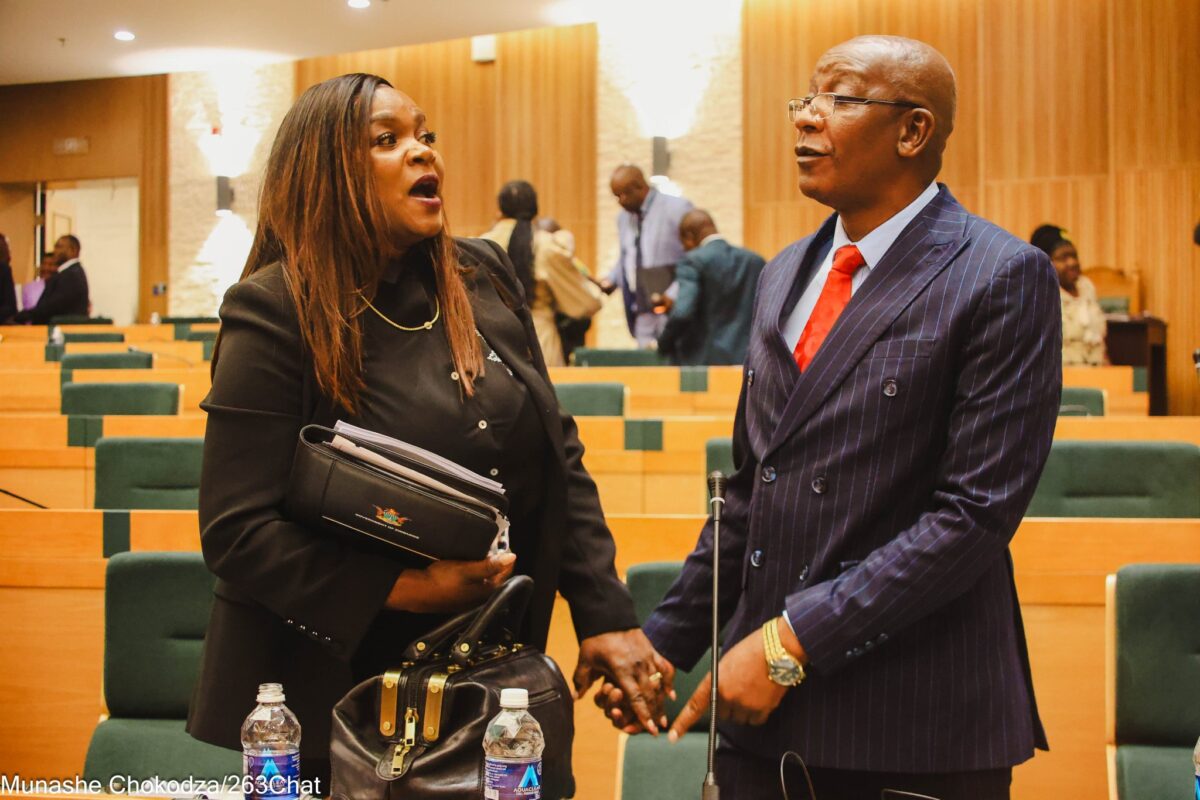
 Attorney General Virginia Mabhiza and justice minister Ziyambi Ziyambi in conversation shortly after bill to amend the constitution was passed by the National Assembly on June 18, 2026
HARARE – The Zimbabwe Council of Churches (ZCC) has renewed its call for a national referendum on the newly enacted Constitution of Zimbabwe Amendment Act No. 3 of 2026 (CAA3), warning that the law’s signing has “deepened national polarisation” rather than settled the dispute over its legitimacy.
In a pastoral letter to the nation on Monday, titled “A Call to Constitutional Fidelity, Peace, and National Cohesion,” the council said the enactment of CAA3 on July 7 had not brought “the contestation of the same into finality,” pointing to the wave of Constitutional Court applications already filed and to citizens who have signalled their intention to demonstrate against the law.
“Instead, CAA3 has deepened national polarisation and generated serious constitutional, political, and moral contestation,” the ZCC said.
“A host of court applications have been filed by citizens and organisations challenging the validity of the Act, while other citizens have expressed an intention to exercise their constitutional right to demonstrate.”
The council said the moment called for “sober leadership” rather than a contest in which “one political side must triumph over another,” describing the constitution as a “sacred covenant” binding all Zimbabweans.
The ZCC’s position is not new. Throughout the passage of the Constitution Amendment Bill No. 3, the church body had maintained that changes touching presidential and parliamentary terms, the method of choosing the president, and term-limit safeguards should have gone to a public vote under section 328 of the constitution, a position it shared with the broader Zimbabwe Heads of Christian Denominations grouping, which includes the Zimbabwe Catholic Bishops’ Conference, the Evangelical Fellowship of Zimbabwe and UDACIZA.
That grouping warned in a February pastoral statement that the bill raised “serious moral and constitutional concerns” and reminded President Emmerson Mnangagwa of his 2024 pledge not to seek a third term or any extension of his current term.
In April, the ZCC went further on its own, calling on parliament to withdraw or revise the bill, describing it as “constitutionally, morally, and democratically compromised.”
Not all church voices have taken the same line. Indigenous churches under the Zimbabwe Indigenous Interdenominational Council of Churches (ZIICC) broke ranks in May, submitting a statement in support of the bill and rejecting calls for its withdrawal, arguing that parliament had the constitutional authority to pass it.
The ZIICC said the decision on the bill lay squarely within parliament’s mandate and was “not the mandate of any church council,” adding that public participation requirements had already been satisfied through nationwide hearings.
In Monday’s letter, the ZCC repeated its call for “a dedicated, independent commission mandated to undertake broad, meaningful consultations rooted in the will of the people,” arguing that the institutions which stood to benefit from CAA3 could not credibly lead the process of consulting on it.
A referendum, the council said, “would not be an act of weakness; it would be an expression of confidence in the people, a safeguard of legitimacy and a means of reducing the division now threatening our common life.”
On the litigation now before the courts – including applications from figures such as Prince Dubeko Sibanda and Vhurande Mahlupeko challenging CAA3’s validity – the ZCC urged restraint from all sides.
“Without prejudging their merits, we call upon all parties to respect these judicial processes and urge the courts to discharge their constitutional mandate independently, impartially, and without fear, favour or interference,” the letter read, adding that no litigant, lawyer, judicial officer or witness should be threatened, intimidated or vilified for taking part in the proceedings.
The council also addressed the prospect of street protests against the amendment, affirming citizens’ constitutional right under sections 58 to 61 to petition, assemble and demonstrate peacefully. It appealed to protesters to act “peacefully, responsibly, and within the law,” warning against violence, property destruction, intimidation or hate speech.
In the same breath, it called on government, police and security institutions to facilitate rather than suppress peaceful protest.
“Law enforcement responses must be lawful, necessary, proportionate, and restrained,” the letter said. “There must be no arbitrary arrests, collective punishment, intimidation or use of force.”
The ZCC pushed back against attempts to frame its advocacy as opposition to the state or as service to foreign interests, describing itself as “a fellowship of Zimbabwean churches whose members belong to this nation, bear its burdens, and seek its flourishing,” citing its role in the liberation struggle and past peacebuilding efforts.
The letter called for an “Inclusive National Dialogue” bringing together political leaders, churches, civil society, traditional leaders, business, women and young people, insisting that such dialogue should not replace constitutional safeguards but instead build consensus toward holding the referendum it is demanding.
It closed with a prayer for the nation, invoking wisdom for those who govern, restraint for security forces and reconciliation for a divided country.