


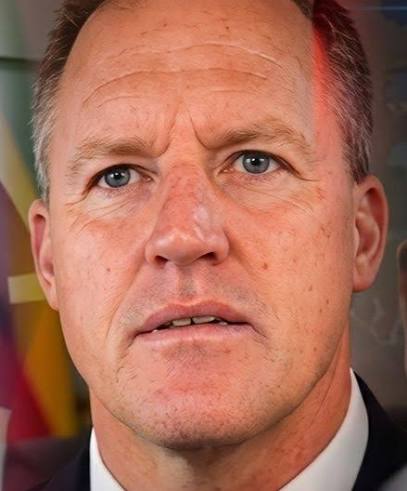
Brett “Muvet” Holley
That at least, is the pitch. Brett Holley is a Zimbabwean businessman and social media personality better known by his public persona, Brett “Muvet”. He has spent recent years building an online following as a political commentator. This past week he announced the launch of Varanda VeZimbabwe, VVZ, translated as Servants of Zimbabwe.
Holley says the party exists to correct what he describes as a basic and obscene mismatch in his country: leaders who fly business class and live in mansions while ordinary Zimbabweans queue for water that may not be clean, hospitals without adequate medicine and classrooms that may or may not have desks.
He says he is doing this without personal ambition, for a legacy he wants to leave his son. He says he lives in a small house, drives an average car, and cleans it himself.
“I am fighting so that other Zimbabweans can have the life that I have,” he said, which is good because he does not claim the moral high ground of poverty. He says he isn’t asking Zimbabweans for a life he doesn’t already have himself.
Who is this man, and why does a country that has seen more opposition parties rise and collapse than most of its citizens can list from memory need to pay attention to one more?
Brett Holley is not new to Zimbabwean public life, even if VVZ is new to Zimbabwean politics. For several years, under the persona name Brett Muvet, he has built an audience, several thousand strong on Facebook and cultivated further on YouTube and X, through political commentary delivered largely in Shona, Zimbabwe’s most widely spoken language. His persona name, “Muvet” is a stylized rendering of muvheti, colloquial Shona for a white person which traces back through the language’s contact with Afrikaans and the colonial-era vocabulary of Rhodesia. Adopting it as a public handle is not incidental branding. It is closer to a white American expatriate in Mexico City calling himself Jonathan the Gringo: a preemptive, self-aware claiming of the label an outsider expects to be given anyway, deployed as armor and introduction at once.
He is also a published author. Earlier this year he released a self-published book titled “How to Fix Zimbabwe.” He pitched this as a blueprint, according to its own marketing copy, for restructuring eighteen government ministries, addressing twenty-five everyday national problems, and building what he calls a citizen-driven political movement from the ground up. Whatever one makes of the specifics, the book establishes something worth noting about Holley as a public figure. He was writing the policy manual before he launched the party.VVZ, as described in reporting on its launch, is structured explicitly around the Zimbabwean diaspora as much as around Zimbabweans at home. Representative offices are reportedly planned in South Africa, the United Kingdom, the United States, Australia, and Botswana, the five countries that between them house a substantial share of the millions of Zimbabweans who have left the country over the past quarter century, most of them for economic reasons, some for political ones.Holley has appealed directly to that diaspora for money, arguing that building administrative offices, outreach programs, and leadership structures requires funding that a movement without institutional backing has to raise from its own supporters.This is an honest admission: new parties in poor countries with authoritarian incumbents do not have campaign finance departments. However it’s the point at which skepticism should start, and does.To understand why Holley’s commentary found an audience large enough to eventually support a party launch, it helps to understand what he was commenting on. For much of the past year, Zimbabwean politics has been consumed by a single fight: Constitutional Amendment Bill No. 3, known universally by its shorthand, CAB3. The bill, gazetted in February 2026 and signed into law by President Emmerson Mnangagwa on July 7 after a bruising legislative fight, extends the terms of the president, parliament and local authorities from five years to seven, replaces direct popular election of the president with selection by a joint sitting of parliament, and, critically, applies the extended term to the current presidential cycle, meaning Mnangagwa’s time in office runs to 2030 rather than the 2028 his current mandate would otherwise have ended.Zimbabwe’s constitution explicitly bars amendments to term-limit provisions from benefiting a sitting officeholder without a national referendum, a safeguard written into Section 328 specifically to prevent incumbents from rewriting the rules mid-game. The government’s position is that it changed the electoral cycle, not the term limit itself, a distinction critics have called semantic gymnastics designed to reach the same result, an incumbent staying in power longer, without submitting the question to voters.Public hearings on the bill drew more than half a million submissions and were marred by disruption and, in at least one documented case, physical assault against David Coltart, a human rights lawyer collecting testimony. War veterans and civic activists have since taken the matter to Zimbabwe’s Constitutional Court, where hearings have proceeded with journalists barred from live courtroom coverage.This is the fight Holley built his following commentating on, and it is not a small or safe topic to build a following on in Zimbabwe. One widely circulated video has him challenging what he calls Zimbabwe’s biggest constitutional myth, walking his audience, in Shona, through the legal argument that CAB3 cannot lawfully apply to an incumbent without a popular vote.Whatever one thinks of his broader political project, this is substantive engagement with an actual constitutional crisis, delivered in the language most Zimbabweans actually speak at home, at a moment when much of the opposition establishment was either compromised, intimidated, or reportedly complicit. Reporting from earlier this year alleged that several opposition senators who had previously pledged loyalty to the 2013 constitution quietly voted for CAB3 behind closed doors, a betrayal, if accurate, that left a vacuum for exactly the kind of outsider commentary Holley was already providing.Now for the part that cannot be sidestepped. I personally think it would be racist and dishonest not to address this because Zimbabwean politics has never been able to sidestep it either. Brett Holley is white. This country’s entire modern political history is inseparable from race: from the white minority rule of Rhodesia, through the liberation war fought explicitly to end it, through the land reform program of the 2000s that forcibly redistributed white-owned commercial farms and, in the process, made whiteness itself a live and contested category in Zimbabwean political discourse in a way it simply is not in most other countries on the continent. A white man launching a political party promising to serve ordinary Zimbabweans is not a neutral fact. It is a fact loaded with the entire history above, and pretending otherwise would do a disservice to both Holley and the country he is trying to organize.This is not merely a matter of public perception or online commentary on my part. Holley has been the subject of actual academic study on precisely this question.A peer-reviewed article published in the journal African Identities, titled “Indigeneity, belonging, ‘madness’ and ‘corruption’: Brett Muvet and the white man’s identity crisis in post-2000 Zimbabwe,” examined years of his Shona-language YouTube commentary through the lens of critical discourse analysis, asking what it means for a white man to perform political belonging in the language and idiom of the Shona majority. The researchers, grounding their analysis in decades of scholarship on whiteness, land, and citizenship in Zimbabwe, concluded that for Holley, in their reading, whiteness remains the point from which his engagement with the nation unfolds, regardless of his claims to indigeneity, and that his commentary reflects what they call the white man’s persistent problem of belonging in the post-colony.This tells us that Holley’s use of Shona and his framing of himself as a servant rather than a leader as well as his repeated emphasis on ordinary poverty rather than personal wealth, are not incidental style choices. Scholars studying Zimbabwean whiteness have identified them as a specific and recognizable genre, a mode of speech through which white Zimbabweans since the land reform era have sought re-entry into a national project that spent the early 2000s explicitly, sometimes violently, defining them as foreign.It would also be dishonest not to note the double standard baked into how Zimbabwean whiteness gets received. Kirsty Coventry, Zimbabwe’s most decorated Olympian, is white and was, for years, embraced by the very ZANU PF establishment that built its legitimacy partly on narratives of white farmers as foreigners who never belonged. Robert Mugabe himself called her “golden girl” and handed her a hundred thousand dollars in prize money at the height of a land reform crisis defined by hostility to whites who claimed exactly the belonging Coventry was being publicly granted. The lesson researchers have drawn from that episode is that Zimbabwean whiteness is not fixed; “it is negotiated, and the terms of that negotiation are set by whether the state finds a given white Zimbabwean useful.” Holley, building a political party that directly challenges ZANU PF’s hold on power, sits on the opposite side of that transaction from Coventry, a champion swimmer who brought the ruling party international glory. The same racial identity that got Coventry a check and a nickname is, for Holley, far more likely to get him branded, by state media and by rivals, as an out-of-place settler with no business telling Zimbabweans how to run their country.None of this settles whether Holley’s politics are good, sincere, or workable. Race explains why his party will draw a particular kind of scrutiny and a particular kind of attack line. It does not, on its own, tell you whether the roads he wants built will get built, or whether his diaspora fundraising model is a serious institution-building strategy or a well-intentioned improvisation.What actually makes Brett “MuVet” Holley different?Strip away the racial optics for a moment and look at the shape of what Holley is proposing. I could proffer an argument that differs meaningfully from the opposition tradition Zimbabwe has produced since 1999. The Movement for Democratic Change, in its original and subsequent splintered forms, along with its most recent successor, the Citizens Coalition for Change, have spent a quarter century organized around charismatic individual leadership, first Morgan Tsvangirai, later Nelson Chamisa, with the party’s internal machinery repeatedly subordinated to the standing of a single man at the top. That structure has produced real courage and real martyrdom, activists like Yvonne Musarurwa spent years in detention for it, but it has also produced repeated splits, expulsions, and vulnerability to exactly the kind of internal capture that CAB3’s passage, with opposition senators reportedly voting for it in private, appears to demonstrate.Holley’s “servant leadership” branding, whatever one makes of its sincerity, is at minimum a rhetorical break from personality-driven opposition politics. He is positioning himself as an organizer of a platform rather than the singular face of a movement, and the diaspora-office model, distributed across five countries rather than centralized in Harare, is structurally different from how CCC and its predecessors have operated.He is also, notably, not carrying the institutional baggage of the MDC lineage, its splits, its expulsions, its accumulated grievances between Chamisa loyalists and rivals like Sengezo Tshabangu, whose maneuvering helped strip several MDC-aligned MPs of their seats in 2023. Holley is building from outside that entire feud, for better and for worse.Better, because he inherits none of its scar tissue.Worse, because he also inherits none of its institutional memory, its trained organizers, or its base of voters who have spent decades identifying as MDC or CCC supporters first and evaluating specific candidates second.None of the above should be mistaken for an endorsement on my part.The critique already circulating in Zimbabwean commentary is straightforward and largely fair: a party announced through social media posts and diaspora fundraising appeals, with no candidates yet standing for office, no demonstrated electoral base, and no formal recognition beyond its own declared existence, is not yet a political party in any functional sense. It is closer to a well-produced pitch for one. Critics have specifically questioned the practicality of what amounts to a movement, in some framings close to a government-in-exile, organizing itself primarily around donations from Zimbabweans who no longer live under the government they are being asked to help unseat, without first demonstrating the broad domestic support and organizational capacity that would make such a project credible rather than aspirational.Diaspora-funded political projects are not unprecedented in African politics, and some have mattered; many more have quietly folded once the initial wave of enthusiasm and PayPal donations receded and the actual grind of building branch structures, vetting candidates, and surviving state harassment set in.Zimbabwe’s political history is, more than almost anything else, a history of movements that looked promising at launch and were ground down by an unforgiving state, by their own internal contradictions, or both.VVZ has offered no evidence yet that it will be the exception. What it has offered is a founder with an unusually large online audience, a coherent public message, a policy document published before the party itself, and a willingness to name the country’s dysfunction in the language most Zimbabweans use at their own kitchen tables, delivered by a man whose own racial identity guarantees that message will be received, debated, and attacked on terms no black Zimbabwean opposition figure would ever have to answer to in quite the same way. Whether that combination adds up to a serious political force or a well-intentioned social media phenomenon is not a question this article, or anyone else, can answer yet. It is a question Zimbabwe will spend the coming months and years answering for itself, watching to see whether Varanda VeZimbabwe can turn a following into a structure, and a structure into votes that a government with every incentive to ignore it will actually have to count.
Kumbirai Thierry Nhamo is an independent writer, social commentator and social justice activist. He can be contacted by email kumbiraithierryn@gmail.com Portfolio: https://muckrack.com/kumbirai-thierry-nhamo