


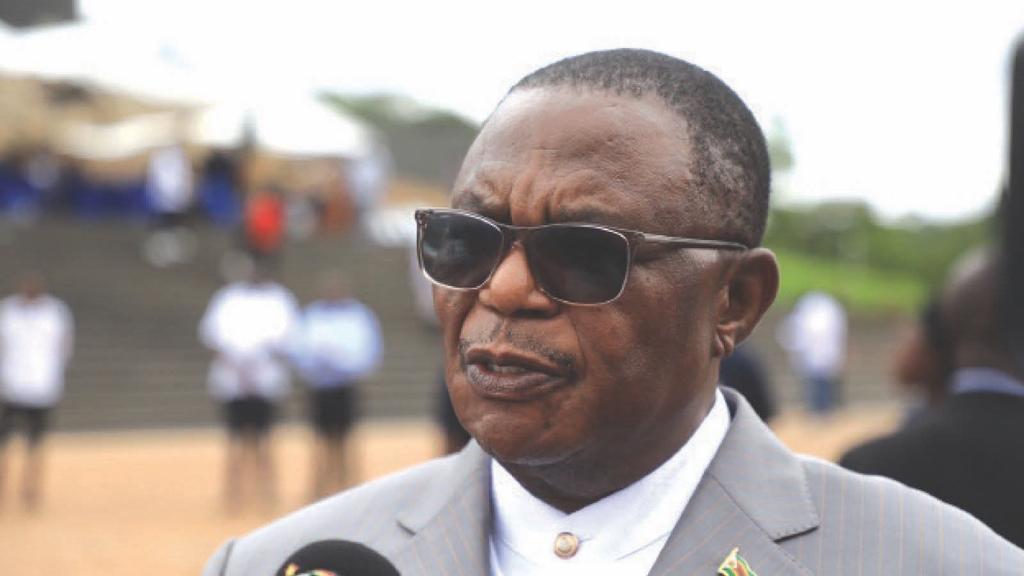
President Emmerson Mnangagwa’s ally and Zanu PF Harare Provincial chairman, Godwills Masimirembwa, has tightened the political noose around Vice-President Constantino Chiwenga by endorsing Mnangagwa’s continued leadership beyond the next scheduled party congress.
The move could further frustrate Chiwenga’s long-standing succession ambitions and deepen the factional struggle over who will eventually succeed Mnangagwa.
Zanu PF Harare Province yesterday resolved that the party’s National Congress, currently due in 2027, should be postponed to 2030 to align the party’s electoral cycle with the country’s amended constitutional framework.
More significantly, the province unequivocally endorsed Mnangagwa as its preferred candidate for First Secretary and President of Zanu PF at the next congress in 2030.
“We have resolved that until the next congress he remains President and First Secretary of the party and at that congress he will be our nominee as party leader,” Masimirembwa said at a Zanu PF inter-district meeting in Harare.
The resolution comes against the backdrop of an increasingly bitter succession struggle within Zanu PF, with 2030 emerging as the new political battleground.
The succession question has deep roots in the ruling party. The 2017 military-assisted removal of former president Robert Mugabe followed an intense struggle over who would succeed him, pitting factions around then-Vice-President Emmerson Mnangagwa against the G40 grouping associated with Grace Mugabe.
Then-General Chiwenga played a central role in the military intervention that ultimately brought Mnangagwa to power.
Eight years later, the two men find themselves on opposite sides of another succession contest.
Mnangagwa is constitutionally due to leave office after completing his second term in 2028. However, Zanu PF has pursued constitutional changes that would shift the electoral cycle from five to seven years, effectively moving the next general elections to 2030.
The amendment process has become a major flashpoint between Mnangagwa loyalists and forces perceived to be aligned with Chiwenga.
For Chiwenga, the political danger is not simply that the presidential election could be delayed.
By keeping Mnangagwa at the helm until 2030, his allies could also prolong the President’s control over Zanu PF structures and potentially weaken Chiwenga’s ability to position himself as the natural successor.
Harare’s latest resolution therefore carries significance beyond the party’s constitutional housekeeping.
It effectively signals to the Chiwenga camp that the succession question is being pushed further down the road while Mnangagwa’s political machinery remains firmly in control.
The irony is that Chiwenga himself has become one of the most vocal critics of the political and economic elite he has labelled “Zvigananda” — a term he has used to describe individuals who accumulate enormous wealth through questionable or unexplained means.
In 2025, Chiwenga described Zvigananda as people who grow “big tummies” through ill-gotten wealth and questionable morals, drawing a distinction between them and ordinary citizens and liberation-war veterans.
Chiwenga subsequently used the term to attack what he described as phantom entrepreneurs and politically connected businesspeople whose wealth has no clear economic foundation.
The term has since acquired a wider political meaning, with critics using “Zvigananda” to describe networks of politically connected elites accused of benefiting from state patronage.
That rhetoric has now fed into the broader succession struggle, as rival Zanu PF factions accuse each other of using wealth, patronage and political influence to consolidate power.
Harare Province’s resolutions therefore represent another front in the battle.
The province also endorsed resolutions calling for the Zanu PF constitution to be reviewed and aligned with the amended Constitution of Zimbabwe, including provisions dealing with the tenure and electoral cycles of party structures.
According to the province, the proposed alignment is intended to promote “constitutional harmony, institutional consistency, stability and continuity.”
The province further called for the expeditious implementation of Constitutional Amendment No. 3, which has become central to the dispute over Zimbabwe’s political succession.
Zanu PF Secretary for Education, Research and Ideology Charles Tawengwa said the province had requested that the party constitution be aligned with Amendment No. 3 as part of its draft resolutions to be considered at the party’s annual National Conference.
“I want to commend the provincial structures for supporting the recently enacted Constitution of Zimbabwe Amendment Act No. 3,” Tawengwa said.
He said the resolutions adopted in Harare were intended to advance the party’s programme while supporting the attainment of National Vision 2030.
“The circular is clear; we want new resolutions that further the revolutionary process while also assessing whether our previous resolutions have been implemented,” he said.
Masimirembwa thanked Harare party members for supporting the constitutional amendment.
But beneath the language of constitutional alignment, party unity and Vision 2030 lies a much more consequential political question:
Who controls Zanu PF when Mnangagwa eventually leaves office — and will Chiwenga still be in a position to claim the succession?
With provinces increasingly declaring their support for Mnangagwa’s continued leadership, the answer is becoming less certain for his deputy.
For Chiwenga, the danger is that the succession battle may be decided not at the next election, but gradually through the reshaping of Zanu PF’s structures, alliances and political timetable.
That could leave the general who helped engineer the 2017 transition facing a very different battle — one in which the political machinery he helped bring to power is increasingly being turned against his own succession ambitions.
Post published in: Featured