


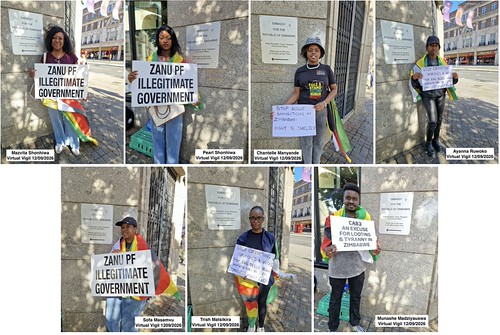
Zimbabwe Vigil Diary 12th September 2026
https://www.flickr.com/photos/
Our virtual Vigil activists today were Munashe Madziyauswa, Chantelle Manyande, Sofa Masamvu, Trish Paidamoyo Matsikira, Ayanna Ruwoko, Mazvita Shonhiwa and Pearl Shonhiwa. They carried placards expressing their dissatisfaction with ZANU PF, Zimbabwe’s ruling regime. Photos: https://www.
Meanwhile, the Kariba Dam disaster and the subsequent government response continues to cause much consternation among Vigil activists and those who believe in the dignity and sacredness of human life. Many are still wondering how a ‘so called people’s government’ presiding over so much wealth could provide so little to the victims. Daily we hear ‘go and see victor’ stories, celebrities being gifted top of the range cars and tens of thousands of cash by ED Mnangagwa’s crony, Wicknell Chivhayo. A thank you to ED will attract another US$20,000. Yet when almost a hundred souls perished in Kariba dam, due to overloading and a mechanically faulty boat, the government could only promise US$100 towards the funeral costs to every family affected. This has left the Vigil bewildered, prompting one activist to write as below.
The Price of a Zimbabwean Life: Why the Kariba Tragedy Led Me to Human Rights Activism.
By Pearl Shonhiwa
On 11 August 2026, the state-run Rural Infrastructure Development Agency (RIDA) ferry, the Mbuya Nehanda, capsized on Lake Kariba on its route toward Chalala fishing camps. An estimated over 150 passengers were crammed onto an ageing, dilapidated vessel built to carry only 90. When rough waters struck, the vessel quickly capsized, drowning dozens of innocent civilians, including young children. This was not merely an unfortunate natural accident. It was the direct, predictable outcome of criminal state negligence, collapsing transport infrastructure, and a complete lack of basic maritime safety regulations.
What followed exposed the absolute moral bankruptcy of the ruling authorities. Rather than taking accountability for failing to protect citizens who rely on state transport, the government offered grieving families a meagre $100 per lost life. To reduce a human soul, a parent, a child, or a family breadwinner, to a one-off payment of $100 is an insult of the highest order and deserves outrage. This does not even cover funeral expenses, let alone provide for the orphaned children left behind.
It communicates clearly that ordinary Zimbabwean lives are considered disposable by the very administration tasked with protecting them.
The bitter irony is impossible to ignore when contrasted with the obscene wealth displayed by state-aligned elites. Politically connected figures like Wicknell Chivayo regularly parade multimillion-dollar luxury car fleets, chartered private jets, and gaudy cash handouts across social media, all funded by unclear state tenders. When hospitals run out of basic painkillers and water transport breaks down, the state claims empty pockets. Yet when it comes to funding the lavish lifestyles of ruling party cronies, the resources are limitless. Beyond Wicknell Chivayo, figures like Kuda Tagwirei and Pedzai ‘Scott’ Sakupwanya embody this culture of state-backed enrichment. Tagwirei, often dubbed the regime’s chief financier through Sakunda Holdings, was sanctioned internationally after funnelling billions through opaque state programs like Command Agriculture while key infrastructure crumbles. Similarly, Sakupwanya, a ZANU PF politician and gold dealer through Better Brands, has flaunted stacks of cash and gold bars online while running unregulated mining operations plagued by deadly cave-ins and safety violations. These individuals thrive on state favouritism and zero accountability, showcasing private riches while ordinary citizens are left to drown on unseaworthy government boats.
This systemic abuse is why I refuse to sit in silence, and why organisations such as the Restoration of Human Rights (ROHR) Zimbabwe (which I belong to) deserve our support. Human rights begin with the fundamental right to life, dignity, and basic safety. ROHR provides a vital platform to document state failure, demand accountability, and protect ordinary Zimbabweans from systemic abandonment. We cannot accept a nation where the corrupt flaunt stolen wealth while ordinary people drown without justice. Every citizen deserves protection, accountability, and a government that values human life over corrupt luxury.
For Vigil pictures check: http://www.flickr.com/
Events and Notices:
- Next Vigil meeting outside the Zimbabwe Embassy. Saturday 19th September 2026 from 2 – 5 pm. We meet on the first and third Saturdays of every month. On other Saturdays the virtual Vigil will run.
- The Restoration of Human Rights in Zimbabwe (ROHR) is the Vigil’s partner organisation based in Zimbabwe. ROHR grew out of the need for the Vigil to have an organisation on the ground in Zimbabwe which reflected the Vigil’s mission statement in a practical way. ROHR in the UK actively fundraises through membership subscriptions, events, sales etc to support the activities of ROHR in Zimbabwe.
- The Vigil’s book ‘Zimbabwe Emergency’ is based on our weekly diaries. It records how events in Zimbabwe have unfolded as seen by the diaspora in the UK. It chronicles the economic disintegration, violence, growing oppression and political manoeuvring – and the tragic human cost involved. It is available at the Vigil. All proceeds go to the Vigil and our sister organisation the Restoration of Human Rights in Zimbabwe’s work in Zimbabwe. The book is also available from Amazon.
- Facebook page: Vigil : https ://www.
facebook.com/zimbabwevigil
The Vigil, outside the Zimbabwe Embassy, 429 Strand, London meets regularly on Saturdays from 14.00 to 17.00 to protest against gross violations of human rights in Zimbabwe. The Vigil which started in October 2002 will continue until internationally-monitored, free and fair elections are held in Zimbabwe.