


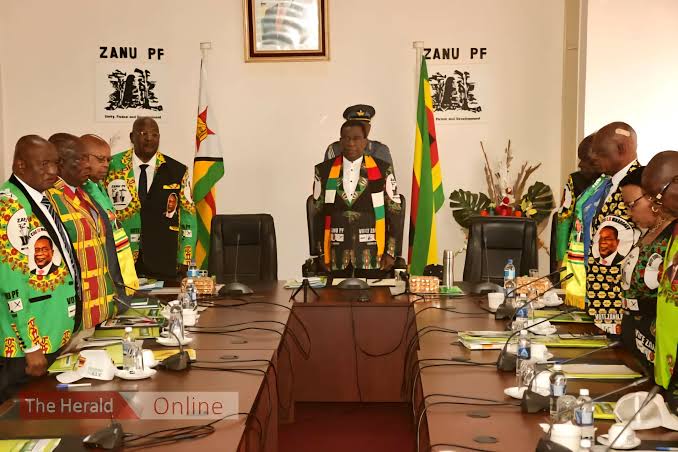
Let me offer some answers on what happened, the underlying power struggle, its political significance and the possible scenarios ahead. Hopefully, this will provoke informed debate.
Q1. Was a Politburo meeting scheduled for Friday, 9 October 2026?
Yes. At 2 p.m., at ZANU-PF headquarters in Harare.
Q2. Did senior party officials turn up?
Yes. Officials travelled from across the country, including the long-absent Obert Mpofu.
Q3. Did the meeting proceed?
No. It was abruptly postponed.
Q4. What explanation did ZANU-PF give?
Christopher Mutsvangwa and Farai Marapira cited a clash of programmes or ‘overflow of presidential programmes ‘.
Q5. Is that explanation convincing?
Hardly. Surely, the leadership knew its own programmes before summoning senior officials from across the country. What suddenly became more important than an extraordinary Politburo meeting?
Q6. Was there a press conference afterwards?
Yes. But instead of explaining the political drama, Philip Chiyangwa addressed journalists about the President’s Ball scheduled for The Hippodrome in Braeside, Harare.
Q7. What is the alternative explanation?
Credible sources point to a confrontation between Mnangagwa and Chiwenga over proposed amendments to the ZANU-PF constitution intended to consolidate Mnangagwa’s hold on power. At the gist is that the process to amend the party constitution violate its own rules.
Q8. What exactly is at stake?
The proposed alignment of the party constitution with CAA3, the extension of Mnangagwa’s party tenure to 2030 and, ultimately, control of the state.
Q9. Why would Chiwenga resist?
The proposed amendments could fundamentally alter party succession arrangements. For Chiwenga, the question is whether his path to the presidency remains open or is being systematically closed. Mnangagwa’s appointment of Kudakwashe Tagwirei, another presidential aspirant, to Cabinet may have sharpened these tensions.
Q10. Why is the postponement politically significant?
In my experience, it is highly unusual for a Politburo meeting to be postponed after senior officials have already assembled. The timing, the circumstances and the unconvincing explanation suggest something more politically serious than a diary clash. Its failure to proceed may tell us as much about the balance of power.
Q11. What could happen next?
Three broad possibilities.
First, a negotiated internal political settlement. Mnangagwa and Chiwenga reach a compromise that preserves party unity, at least temporarily. This could involve postponing the constitutional amendments at Chinhoyi or proceeding with them alongside credible political guarantees for Chiwenga. Either way, both sides would need sufficient concessions and assurances to make compromise preferable to confrontation. The succession struggle would be managed, not necessarily resolved.
Second, political neutralisation. Mnangagwa unilaterally proceeds with the amendments, further closing Chiwenga’s path to the presidency. This is because Chiwenga’s political significance does not rest on control of ZANU-PF structures. The critical question is whether his residual influence within the security establishment can be contained.
Third, a confrontation beyond party politics. If negotiations collapse, the succession struggle could move from party institutions into the security establishment. With both factions potentially drawing on armed networks, an unresolved elite conflict could become a wider struggle over control of the state, carrying the risk of violence and national instability.
We shall hear.
Zamchiya
Post published in: Featured