


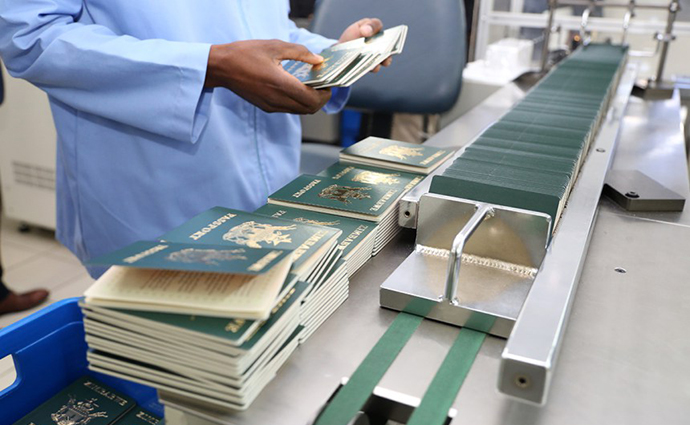
 Too expensive … The Zimbabwean passport is one of the most expensive in Africa
HARARE – A Zimbabwean passport costs US$170. Across the border in Zambia, a comparable 48-page booklet goes for US$18.21. That gulf, the Zimbabwe Human Rights Commission (ZHRC) argues, has put a constitutional right beyond the reach of most citizens.
In a policy brief on Tuesday calling for fees to be slashed, the commission says Zimbabwe’s fees, US$170 for an ordinary passport and US$270 for an emergency one, are the highest in the region. Its comparison of eight other Southern African Development Community (SADC) states puts the average cost of an ordinary 32-page passport at US$17.39, making Zimbabwe’s roughly 878 percent more expensive.
Eswatini charges US$16.10 for a 48-page passport; Malawi, US$74.98.
The fee has climbed fast. The ZHRC says an ordinary passport cost US$53 in 2020, meaning the price has more than tripled in six years.
The commission argues the bill lands on households already stretched thin.
Citing the Zimbabwe Statistics Agency’s 2019 mini poverty survey, it says six million Zimbabweans, or 36.8 percent of the population, were living in extreme poverty, up from 4.5 million in 2017.
The ZHRC does not dispute that the service itself has improved. Decentralisation, digitisation and the e-passport have cut processing to seven working days, it says, but “this efficiency has come at a price that most Zimbabweans cannot afford.”
The commission is asking the government for five things: fees brought down to levels comparable with SADC neighbours; a cheaper passport with fewer than 48 pages for people who rarely travel; concessionary pricing for persons with disabilities and senior citizens; lower fees for children, whose passports the brief says are valid for five years yet priced the same as an adult’s; and the right to pay in local currency.
Mauritius, the ZHRC notes, charges senior citizens, disabled people and children Rs400 (about US$8.55), just over half the adult fee.
On currency, the commission says passport fees can be paid only in foreign currency, even though Zimbabwe runs a multi-currency system in which salaries, farm sales and retail trade are settled in both Zimbabwe Gold (ZWG) and US dollars. That, it argues, is contrary to section 6 of Statutory Instrument 60 of 2024 and section 25 of the Finance Act, 2024, which make ZWG legal tender in all transactions.
There is a wider economic cost, according to the ZHRC. Expensive passports push people towards irregular migration, with its risks of detention, financial loss and assault, and choke off the diaspora remittances the 2025 national budget projected would reach US$2.51 billion this year.
The commission’s recommendations are addressed to three arms of the state. The ministry of home affairs and cultural heritage is urged to cut fees and introduce the cheaper options. The ministry of finance is asked to review the passport production process for cost drivers, subsidise production and increase budget support to the Civil Registry Department so it leans less on passport fees for revenue. Parliament’s portfolio committee on defence and home affairs and the thematic committee on human rights are asked to debate the reduction.
Who makes Zimbabwe’s passports, and on what terms, has been a running question. In 2021, ZimLive reported that government had handpicked Belgian firm Semlex to produce biometric passports under a build-own-operate-transfer arrangement, without advertising the tender.
Investigations by the Organised Crime and Corruption Reporting Project and Reuters had linked the company to bribes-for-contracts in several countries. At the time, an ordinary Zimbabwean passport was pegged at US$60.
Home affairs minister Kazembe Kazembe told ZimLive then that the investor would “recoup from the revenue”. Asked whether prices would rise, he stopped short of a guarantee: “Prices will be agreed by the ministry of finance and the investor. The citizens will be protected.”
The ZHRC makes no mention of Semlex or the contract.