


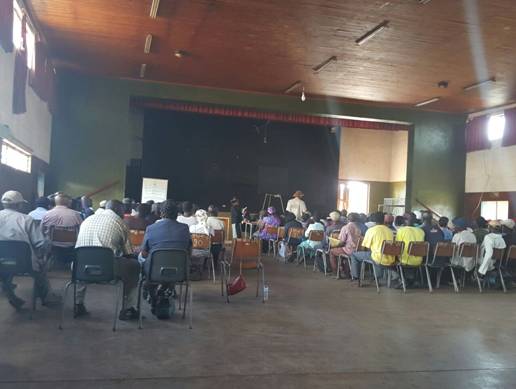
Some of the participants who attended the Bindura hearing
The hearings ending on the 20th of April were rushed and the Bill’s consultative process falls short of thorough public scrutiny as many citizens did not have an opportunity to read the draft legislation. Central issues that dominated both meetings were revolving around the sweeping powers conferred to the Minister, distrust among citizens about the potential effectiveness of the NPRC, need for compensation and standard remedies.
The public hearing held in Bindura was led by Honourable Senator Mumvuri while in Plumtree, Hon Jessie Majome led the process. Both meetings had fair attendance of approximately 180 and 120 people in Bindura and Plumtree, respectively. However, participants complained about the non-availability of the draft legislation copies. In Bindura the horrors of the 2008 elections emotionally affected participants who narrated torture experiences from Tendai Hall where the hearing was being conducted. Participants clamoured for restorative justice mechanisms to be clear in the Bill.
Below are the issues that were raised by participants in Bindura during the public hearing.
- a) The Bill must clearly stipulate compensation as part of restorative justice remedies, with specific standards.
- b) The government was also considered a chief perpetrator of human rights violations who should provide compensation to victims
- c) The Minister has sweeping powers that takes away the independence of the Commission
- d) NPRC investigations should have investigations timeframe beginning from 1980
- e) That the government should consider consulting the grassroots when rolling out the NPRC programmes
- f) The NPRC should be decentralized from the national to the ward levels
- g) Reports of the Commission should be submitted directly to Parliament without having the Minister getting involved
- h) Church leaders, survivors and victims of violence are part of the NPRC programme processes.
- i) That advertisements should be avoided in the Bill and the Minister should not have powers to issue a certificate of non-disclosure
- j) That police officers who corroborated with perpetrators by abusing their offices should be prosecuted
- k) The media should play a critical role in publishing the work of the Commission and investigations conducted
- l) The NPRC should have additional functions such as providing counseling and education.
- m) Funding of the Commission should not be limited by approvals from the Minister
- n) The Bill does not provide explanation on how the Commission will handle conflicts between arms and departments in the government.
- o) The past Commissions reports (such as the Dumbutshena and Chihambakwe reports) should be published and their recommendations implemented in order to test the possible effectiveness of the NPRC.
In Plumtree the hearing started off well but the only challenge being the shortage of copies of the bill. The Parliamentary team highlighted the role the NPRC in healing, reconciliation and gave a brief summary of the bill. Well-wishers in Plumtree provided copies of the Bill to the participants. In addition, Gukurahundi reminiscences engulfed the Plumtree meeting atmosphere.
Participants also blasted the Parliamentary team which had failed to provide copies of the bill before the hearing. The Parliamentary team however urged participants that they could write to Parliament and request for a repeat of the hearing in case they were not satisfied with the process. Below are some of the contributions from the Plumtree hearing:
- a) Parliament failed to raise awareness on the bill and this will compromise views on bill
- b) The commission must be independent and report to Parliament and not the Minister
- c) The bill fails to mention how it will deal with conflict between arms of government
- d) The bill fails to clarify how it will handle the Gukurahundi atrocities and does not advocate for compensation
- e) The issue of people being abducted and disappearing is a present hour issue that the NPRC must tackle
- f) The Minister  should not have power to issue a certificate
- g) The NPRC is a waste of resources since we have many commissions in Zimbabwe which have yielded nothing
- h) What alternative is there if the Commission fails to deal with conflict cases
- i) The bill does not encourage truth telling
- j) The process of the NPRC is a rushed process
- k) The State has a long history of violating people’s rights and people are suspicious why the same State appointed a Minister to lead healing and reconciliation processes
- l) It is not feasible to have an effective NPRC when the majority of perpetrators are in government
- m) People are afraid to talk freely about healing and reconciliation issues
- n) The bill should categorize types of violations and conflicts
- o) How will the Commission gain lost time given that it has already lost 3 years of its tenure and yet achieved nothing
- p) The NPRC bill process should go to rural areas where most violations took place
- q) The bill is silent on decentralization and the commission should utilize enquiries and investigations carried out by past commission such as the Chihambakwe Commission
- r) Why has the government failed to take action on Gukurahundi and the 2008 violence
- s) Prosecution language in the bill does not encourage healing and reconciliation
- t) The perpetrator should own up and talk openly about reconciliation.
Heal Zimbabwe will continue to provide these updates to the members of the public as well as monitoring the reaming consultative meeting processes. Below are the remaining public meetings
| Team A Date | Place | Venue | Time of Public Hearing |
| 16 April | Lupane | Lupane Local Board Community Hall | 1030hrs |
| 16 April | Bulawayo | Bulawayo Holiday Inn | 1500hrs |
| 20 April | Harare | Senate Chamber | 1000hrs |
| Team B Date | Place | Venue | Time |
| 16 April 2016 | Chinhoyi | Cooksey Memorial Hall | 1400hrs |
| 20 April 2016 | Harare | Senate Chamber | 1000hrs |