


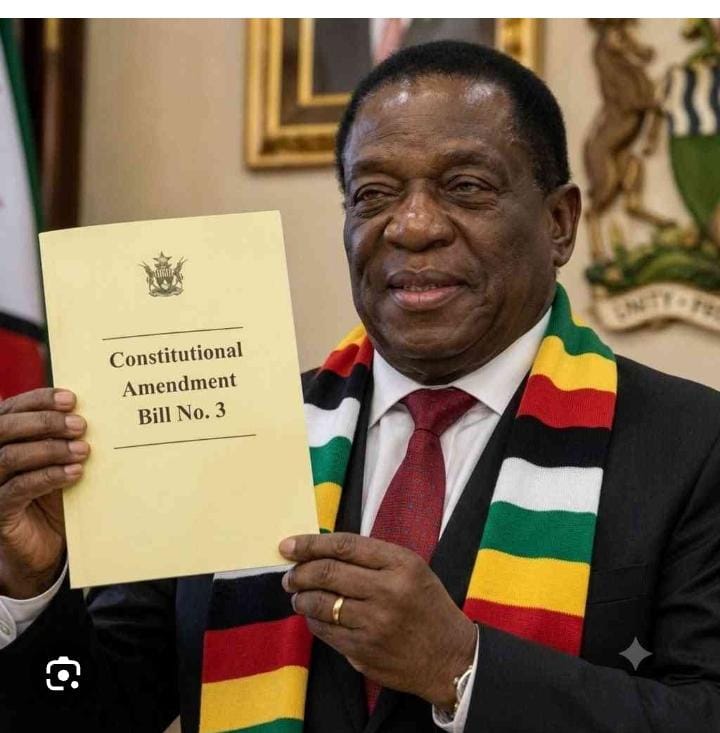
The way this amendment has been enacted marks one of the darkest moments in Zimbabwe’s constitutional history and reveals a disturbing disregard for constitutionalism, transparency, and democratic accountability.
The Constitution of Zimbabwe is not the private property of the Executive; it is the supreme law of the Republic, established through one of the most extensive consultative processes in our nation’s history. Any amendment to this constitutional framework should reflect openness, public participation, and respect for the sovereign will of the people. Instead, Zimbabweans have experienced what can only be termed a constitutional ambush.
The decision to sign the amendment quietly behind closed doors, without transparency or allowing the nation to fully understand the significance of the changes, is fundamentally inconsistent with the spirit and values of constitutional democracy. Constitutional amendments are not ordinary administrative acts. They change governance, redefine the balance of power, and directly affect the rights and expectations of citizens. Such actions should never be conducted in secrecy.
ZICOMO asserts that CAB3 is a calculated attempt by President Emmerson Mnangagwa to entrench his position as life president and lay the groundwork for a Munhumutapa dynasty.
The extension of presidential terms, the removal of direct presidential elections, and manipulation of succession clauses are not about good governance; they are about personal rule and the transfer of power within a family and a select group, rather than to the people.
This directly undermines the spirit of the 2013 Constitution, which Zimbabweans fought to protect against life presidency and the removal of term limits. We will not allow a return to one-man rule.
What makes this situation even more alarming is that Constitutional Amendment No. 3 faced opposition from significant sectors of Zimbabwean society from the outset. Civil society organizations, constitutional experts, lawyers, churches, labor movements, and ordinary citizens have consistently warned that the amendment represented a dangerous step toward the concentration of executive authority and the gradual erosion of the constitutional safeguards painstakingly negotiated during the constitution-making process.
Those warnings have been ignored.
The Government has opted to undermine constitutional democracy rather than strengthen it. It has prioritized political expediency over a genuine commitment to constitutional values. Instead of viewing the Constitution as a social contract between the State and its citizens, it has treated it as a political tool that can be altered when it becomes inconvenient for those in power. This is precisely the constitutional culture that Zimbabwe sought to escape in 2013.
The Constitution was designed to ensure that no individual or political party could manipulate the supreme law for short-term political gain. Constitutional amendments should be exceptional, not routine. They should promote democratic participation, not diminish it. They should strengthen institutions, not concentrate power.
The process leading to the enactment of CAB3 has been flawed from the beginning. Public consultations were marred by violence, intimidation, kidnappings, and death threats. Citizens were denied meaningful participation.
Moreover, Parliament’s claim that 537,000 submissions supported CAB3 has not been independently audited or verified. Statistics cannot be used to manufacture consent.
ZICOMO rejects the argument that Parliament alone can amend term limits. Section 328 of the Constitution clearly states that amendments affecting the Presidency, the electoral system, and the Declaration of Rights require a referendum.
ZICOMO is particularly concerned about the growing pattern of constitutional instability under the current administration. Frequent constitutional amendments undermine certainty, weaken investor confidence, erode public trust in democratic institutions, and create the impression that constitutional rules only exist until they become politically inconvenient.
A Constitution cannot serve as the supreme law if it is continually subject to politically motivated changes. Constitutional democracy relies on restraint. It requires those in power to recognize that not everything legally permissible is constitutionally legitimate.
We further reiterate that constitutional legitimacy derives not only from parliamentary numbers but from public confidence, constitutional morality and adherence to democratic principles. Majoritarianism alone cannot substitute for constitutionalism.
Zimbabwe deserves better.
Our Constitution belongs to the people—not to the Executive, Parliament, or any political party. Therefore, ZICOMO:
- Demands the immediate suspension of the operationalisation of the Amendment pending a national referendum.
- Calls for a national referendum to be held within 90 days, allowing the people of Zimbabwe to decide on Constitutional Amendment No. 3 (CAB3).
- Requests the full publication and independent audit of all public submissions made to Parliament.
- Advocates for an end to the intimidation of citizens, civil society, and Members of Parliament.
- Urges all constitutional institutions to faithfully uphold and defend the Constitution against further erosion.
- Encourages civil society, churches, labour groups, students, professional bodies, and citizens to remain vigilant in defending constitutional democracy.
- Calls on the legal community to continue exploring all available constitutional remedies to test the validity and implementation of the amendment where appropriate.
- Asks regional and international democratic institutions to closely monitor the continued deterioration of constitutional governance in Zimbabwe.
- Urges Parliament to recommit itself to protecting, rather than undermining, the constitutional order.
History teaches us that constitutions rarely collapse in a dramatic moment; instead, they are gradually hollowed out through incremental changes that normalise executive excess and diminish democratic safeguards. Zimbabwe must refuse to accept constitutional regression.
ZICOMO remains committed to defending the supremacy of the Constitution, the sovereignty of the people, and the principle that constitutional power must always remain subordinate to constitutional limits. The struggle to defend the Constitution does not end with the enactment of Constitutional Amendment No. 3; it enters a new and more determined phase. The Constitution is not a political convenience; it is a national covenant.
Post published in: Featured