


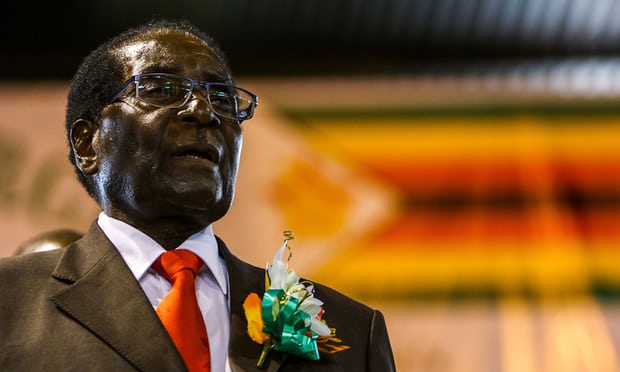
‘Surely Zimbabweans would want to see Robert Mugabe answer in court for what he has done. Surely they would yearn for justice?’ Photograph: Jekesai Njikizana/AFP/Getty Images
Perhaps, as the Guardian’s Africa correspondent Jason Burke suggests, Robert Mugabe will stay on as a “figurehead”, while those who ousted him get on with governing the country. Alternatively, there’s the suggestion floated in a BBC interview this morning by Tendai Biti, a Zimbabwean opposition leader and former finance minister: that Mugabe head for exile in Singapore, which has served in recent years as a virtual “second home” for the 93-year-old. If Mugabe and his “beautiful wife” wanted to go there, said Biti, “no one should prevent him”.
I wonder how either scenario would sound to those Zimbabweans who blame Mugabe for reducing their once-prosperous country to penury. Or those whose loved ones were jailed, beaten or killed on Mugabe’s orders. Surely they would very much want to prevent the dictator either retaining his title or enjoying his final years in comfort and safety in a foreign capital. Surely they would want to see him answer in court for what he has done. Surely they would yearn for justice.
Yet perhaps Biti had in mind the experience of other nations, in Africa and beyond. Contrast, for example, the fate of two nations whose leaders were ousted during the Arab spring of 2011. In Libya, Muammar Gaddafi was hunted down and caught by rebels, who in the name of revenge beat him to a brutal death. In Tunisia, Zine al-Abidine Ben Ali ended his 23 years in power by boarding a plane to exile in Saudi Arabia. Libya remains a country in turmoil, while Tunisia boasts that it is the sole democracy of the Arab Middle East – and the one success story of 2011.
Now perhaps that is a coincidence, owing nothing to the very different fates of the two deposed leaders. But it’s undeniable that societies that make the transition from dictatorship often have to sacrifice the urge to see the dictator himself brought to justice. In Chile, there were tens of thousands of families who saw Augusto Pinochet as the murderer of their son or daughter, father or sister. And yet, in order to see him removed from power, they had to watch as he was granted the special status – initially anointed a “senator for life” – that would allow him immunity from prosecution. As a would-be Chilean prosecutor ruefully put it: “Our country has the degree of justice that political transition permits us to have.”
It is an age-old tension, known to all societies emerging from conflict. Sometimes it means allowing the release of prisoners guilty of acts of great violence – witness the Good Friday agreement in Northern Ireland; sometimes it means allowing the most brutal dictators to walk away scot-free, never brought to account. The bleak truth that Zimbabwe might be about to demonstrate once more is that, even though it is human to long for justice and peace, we can often have one or the other – but not both.
• Jonathan Freedland is a Guardian columnist
One has to understand why some may say let Mr. Mugabe go quietly is due to his struggle with Ian Smith of White Rule Rhodesia and what it stood for. But what has followed has been dismal where the hopes of a better than Ian Smith’s Rhodesia, now Zimbabwe has not come to fruition for all Zimbabwean. One has to read the history of Mr. Robert Mugabe and how the history of Mr. Ian Smith intersects and collides.
I do not think Singapore will want them there. Singapore LAWS are totally against corruption and does not view deposed Despots,Dictators and Money Launderers favorably and NO EXCEPTIONS. BOTH of them would be in jail in Singapore if they had tried it there and for a VERY long time. He would never have survived even a few months and I doubt her too.
The money Mugabe has hidden around the world needs to be returned for the use of the people of Zimbabwe. It is a pity that it will again end up in the hands of the new Boss of Zimbabwe and nothing will go to the infrastructure or population.