


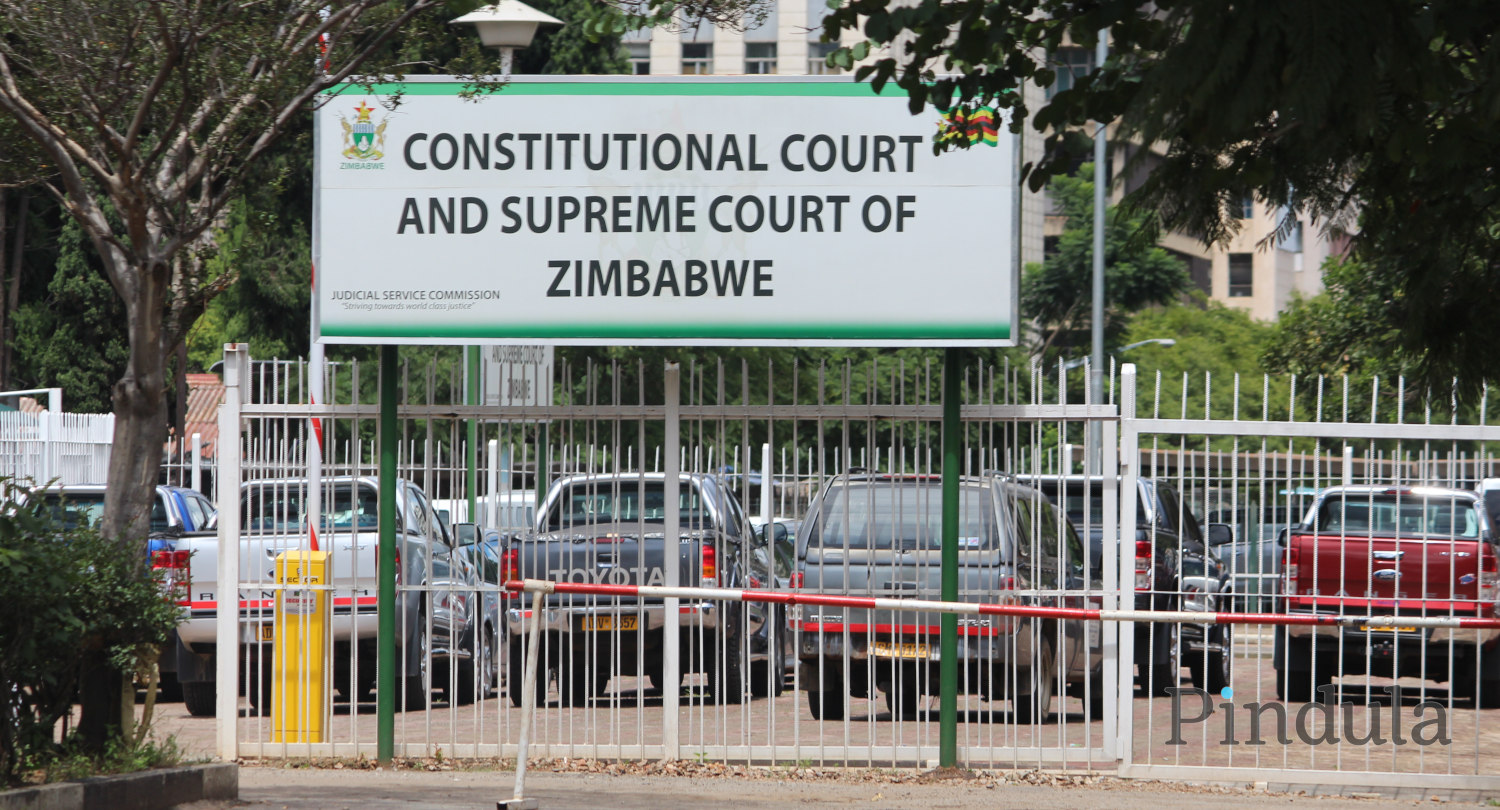
The Act, commonly known by the name of the Bill that became it, CAB3, was signed by President Emmerson Mnangagwa in July. It shifts the election of the president from a direct public vote to a parliamentary electoral college and extends presidential terms from five to seven years, delaying the next polls to 2030.
The court had been due to hear two separate matters, one brought by the MDC and another brought by two war veterans. Both challenge the validity of the amendment. The challengers, including MDC president Douglas Mwonzora, argue that it undermines voting rights and requires a referendum. The State insists that proper processes were followed.
Speaking outside court, lawyer Professor Lovemore Madhuku, who was representing the MDC, said the delay in his party’s case had come from his own side.
“I had sought a postponement myself because there were issues that I needed to get,” he said. “I had not done the paperwork, and there were additional arguments we wanted to make.”
He said it had been agreed that the matter would be postponed to enable him to supplement his papers.
The State then used that postponement to seek a postponement in the war veterans’ case, Madhuku said.
“In our case they then used our excuse to want to postpone the other,” he said.
He said the State had initially refused a postponement when the parties first went into chambers, but later changed its position.
“We were extremely disappointed by the State now riding on the back of the first matter of the MDC,” he said. “We didn’t think that they were bona fide and we told the court we didn’t trust them. We think they’re up to something. Hopefully we’ll be proved wrong, but we’re extremely disappointed that the matter was not argued.”
Madhuku outlined the war veterans’ case, saying it was focused on political rights.
“The applicants are saying that when CAB3, in section 92, removes the right of Zimbabweans to choose their president, it is basically amending, expressly or impliedly, section 67 of the Constitution which gives political rights,” he said.
He added: “Section 67 says every citizen has a right to choose and elect someone in an elective office. So if you take away the right of Zimbabwean to choose their president, you’ve affected that right.”
The applicants also argue that the amendment breaches the Constitution by allowing an incumbent to benefit from an extension of his term.
“By the President signing and Parliament passing a law that allows the President to benefit from an extension of his term of office, it is clearly in breach of section 328 subsection 7 of the Constitution,” Madhuku said.
He said the delay was frustrating because of the national importance of the case.
“CAB3 is in the national interest. The country has frozen because of CAB3,” he said. “It is important that one way or the other the Constitutional Court makes a decision on matters that Zimbabweans are desperate for clarity and decision.”
MDC president Douglas Mwonzora, who spoke after Madhuku, said his party was satisfied with what had happened in court, despite the postponement.
“We are happy with what has gone on in court,” he said. “The most important thing is that there is a judgment that the State wanted to climb on.”
That judgment, he said, was the Mujuru matter, which the State was using to argue that a president does not have to interrogate a Bill placed before him.
“This judgment seems to suggest that when a bill is brought to a president, they don’t have to analyse it. They don’t have to think about it. They’ll just have to sign,” Mwonzora said. “We want, through Professor Madhuku, to prove that it is wrong to reason that way.”
He argued that the Constitution does not create a passive presidency.
“The president that the Constitution brings into being is not a zombie,” he said. “In other words, he is not a rubber stamp. He must read documents brought to him.”
Mwonzora said that if President Mnangagwa had properly considered CAB3, he would have seen its effect on the right to vote.
“Had President Mnangagwa read CAB3, he would have noticed that it was taking the right of the generality of Zimbabweans to vote for their president and putting it into Parliament,” he said. “Faced with that, he was duty-bound to then call for a referendum. That he did not do so means that he neglected his duty as president to call for a referendum.”
He said the MDC wanted to bring foreign case law before the Constitutional Court to support that argument.
“We want to bring these German authorities before this Constitutional Court,” Mwonzora said. “Court cases decided in other countries are what we call persuasive authorities in our court. So we do have German cases, some European cases, which prove that the reasoning by the State is wrong.”
“The president must read what is brought to him and must apply his mind. That is what we want the court to decide upon,” he said.
Mwonzora urged supporters to remain patient and framed the challenge as a defence of the Constitution and the liberation struggle.
“We urge Zimbabweans to be patient. We are defending the Constitution. We are defending the ideals of the liberation struggle,” he said. “It was one of the principal ideals of the liberation struggle that there must be one person, one vote. And this is what we are seeking to defend.”
He added: “Whether they delay these proceedings or not, the day of reckoning is coming. We want to thank Zimbabweans for uniting in defence of their Constitution.”