


 [1st September 2016]
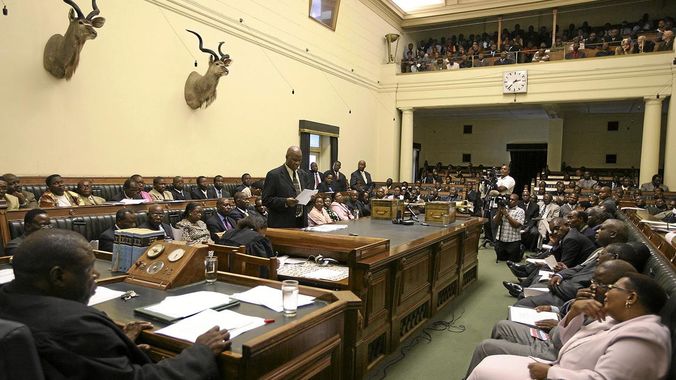
The National Assembly is in Recess until 8th September
The Senate is in Recess until the Next Parliamentary Session
The Next [4th] Session of the Present [8th] Parliament will Start on 4th October
Next Parliamentary Session to Start Tuesday 4th October
SI 101/2016 of 26th August contained a proclamation fixing 12 noon on Tuesday 4th October for the ceremonial opening by the President of the Fourth Session of the present Parliament.
The Senate has already adjourned to 4th October.
For the National Assembly, however, the present Session is not over. It will sit again next week, on Thursday 8th September, but only to hear the Mid-Term Fiscal Policy Review, to be presented by the Minister of Finance and Economic Development [see Bill Watch 37/2016 of 30th August].
New Bills For the Next Session
As briefly noted in Bill Watch 38/2016 of 31st August two new Bills were gazetted on Friday 26th July. They are summarised below. It will not be possible for these Bills to be introduced when the National Assembly sits next week for the Mid-Term Fiscal Policy Review. They will, therefore, have to wait until next Session.
Deeds Registries Amendment Bill
The Bill [available via this link to the Veritas website] is to amend the Deeds Registries Act (“the Actâ€). It merits careful study by all legal practitioners and their IT advisers.
The explanatory memorandum published with the Bill states that it has two objectives—
- Powers of attorney Section 78 of the Act will be amended to restrict the range of persons who may witness the signing of a power of attorney to pass deeds or to do any act in connection with a deeds registry. Permissible witnesses will be limited to legal practitioners, notaries public and justices of the peace, and their signatures will have to be affixed to a deed in the presence of the person signing the deed. Powers of attorney witnessed by commissioners of oaths and competent witnesses will no longer be accepted for deeds registry purposes.
- Provision for electronic registry A new Part VIII, headed ELECTRONIC REGISTRY, will be added to the Act. It will permit the digitisation of the deeds registry and the establishment at some future date of an electronic registry which will supplement the existing paper-based one. The aim is to expedite deeds registry administration.
When assessing the Bill, stakeholders will need to consider this question: If the Bill becomes law, will the Act cater satisfactorily for the consequences of the agricultural reform programme and its changes to land tenure in rural areas?
Judicial Laws Amendment (Ease of Settling Commercial and Other Disputes) Bill
The Bill [available via this link to the Veritas website] aims to amend the High Court Act, the Magistrates Court Act and the Small Claims Courts Act.
According to the explanatory memorandum published with the Bill, its purpose is to speed up and otherwise facilitate the settlement of certain kinds of legal proceedings, especially those of a commercial nature. In fact, as indicated below, the Bill does rather more than that, and it also raises issues of constitutional alignment. Matters provided for include—
- Specialised divisions of the High Court *
- Virtual sittings of the High Court and magistrates courts
- Use of electronic means to serve process and authenticate documents
- Digitisation of court records
- Magistrates courts will have new jurisdiction in “commercial disputesâ€
- All magistrates courts will be small claims courts automatically [but there is still room for other small claims courts presided over by non-magistrates]
- Companies and other “juristic persons†will be allowed for the first time to institute small claims court proceedings [at present they can be sued, but cannot themselves sue]
- Legal representation will be allowed in small claims courts **
- Speeding-up the issue of small claims court summonses [at present a defendant has 14 days after receiving the plaintiff’s letter of demand within which to pay up and avoid a summons; clause 12 will shorten that to 7 days].
* Specialised divisions of High Court Section 171(3) of the Constitution allows an Act of Parliament to provide for the High Court to be divided into specialised divisions. Clauses 2 and 5 of the Bill provide for such divisions.
Clause 2 will enable the Chief Justice to establish specialised divisions by notice in the Government Gazette. Whether this clause complies with section 171(3) is doubtful.
Clause 5, headed Savings, is a questionable attempt to legitimise the continued use of High Court judges as judicial officers in three other courts [Electoral Court, Fiscal Appeal Court and Intellectual Property Tribunal] in the face of the clear words of section 183 of the Constitution: “Except as otherwise provided in this Constitution, a person must not be appointed as a judicial officer of more than one courtâ€. A two-or-more-hats arrangement for High Court judges was acceptable under the former Constitution, but it is now inconsistent with that section and unconstitutional; and that has been the case since 22nd August 2013 when the present Constitution came into force. Instead of making appropriate amendments to the High Court Act, the Electoral Act, the Fiscal Appeal Court Act and the Intellectual Property Tribunal Act, however, clause 5 declares “for the avoidance of doubt†that the three courts concerned “are specialised divisions of the High Courtâ€. For reasons that will be spelt out in another bulletin, Veritas believes the clause does not provide the Government’s desired solution, which is to make these three courts specialised divisions of the High Court, thereby permitting the use of High Court judges as their presiding officers.
** Right to legal representation in Small Claims Court This is to bring the Small Claims Court Act into line with section 69(4) of the Constitution, which recognises everyone’s right “at their own expense to choose and be represented by a legal practitioner before any court, tribunal or forumâ€. Â
Note: No change is proposed to section 27 of the Act, which limits costs awards to the court fee for issuing the summons and the expenses of the messenger of court; so a small claims court will not have the power to allow a successful party to recover from the defendant the costs incurred in hiring a legal practitioner. As between a party and his or her lawyer, the lawyer will be limited to getting the amount appropriate in similar magistrates court proceedings or the amount allowed under the tariff, if any, prescribed in the rules for small claims courts made under section 31 of the Act, whichever is the lesser.Â
Comment: Section 69(4) of the Constitution also applies to local courts operating under the Customary Law and Local Courts Act, i.e., chiefs courts and headman’s courts. Section 20(2) of that Act prohibits legal practitioners from representing clients in local courts and is therefore invalid for inconsistency with the Constitution. The present Bill does not take the opportunity presented to repeal this invalid prohibition. The Bill should be amended to include such a repeal, to avoid presiding officers, legal practitioners and litigants in the local courts being misled by section 20(2). Â
Norton By-election Proclamation Gazetted
SI 93/2016, gazetted on 19th August is the Presidential proclamation fixing dates for the by-election to fill the National Assembly constituency seat for Norton, previously held by Christopher Mutsvangwa. [SI available via this link to the Veritas website] —
- Nomination court: Â Tuesday 6th September at the Magistrates Court, Chinhoyi
- Polling day: Â Â Saturday 22nd October.
Other vacancies that will require by-elections
The Speaker has previously announced two other vacancies in ZANU-PF National Assembly constituency seats—
- Bikita West  This vacancy in terms of section 129(1)(i) of the Constitution was announced on 20th July, following the sentence of 14 years’ imprisonment for rape imposed on the incumbent MP Munyaradzi Kereke on 11th July.  Why hasn’t the President called this by-election?  Perhaps, because on 21st July, i.e. after the Speaker’s announcement of the vacancy, Mr Kereke noted an appeal against conviction and sentence, thereby raising the possibility that the basis of the vacancy may fall away.  Section 129(1)(i) says that a seat becomes vacant on conviction and sentence unless on appeal the conviction is set aside or sentence reduced to less than six months or to a punishment other than imprisonment; and section 129(2) says that a convicted Member who has appealed may, until the final determination of the appeal, continue to exercise the functions of an MP and to be paid as such, unless detained in prison pending the appeal’s outcome.  Dr Kereke is still detained in prison, and therefore unable to take advantage of section 129(2); but the loss of his seat is on hold.
- Chimanimani [a section 129(1)(k) vacancy announced on 17th August following the expulsion from ZANU-PF of incumbent MP Munacho Mutezo]. Â Assuming prompt notification to the President, the by-election proclamation should be gazetted on or before 31st August or very shortly thereafter.
Â
Veritas makes every effort to ensure reliable information, but cannot take legal responsibility for information supplied
Post published in: Featured