


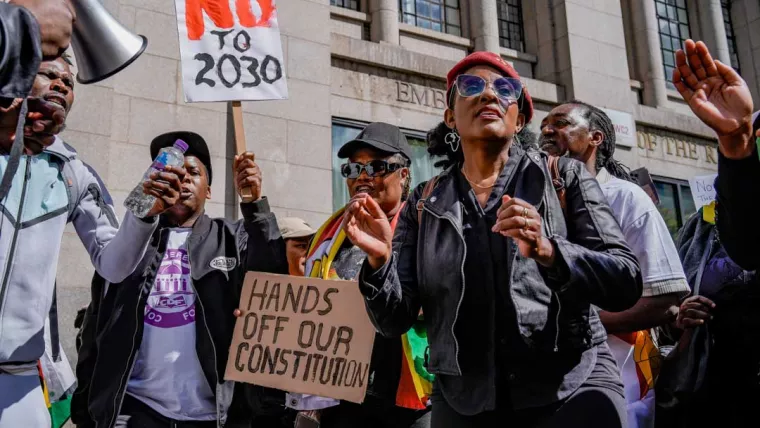
Zimbabwe is in the middle of a political and constitutional crisis. In February, the cabinet introduced Constitution Amendment Bill No. 3, commonly referred to as CAB3, which proposes sweeping changes to the 2013 national charter. Most striking among these is the extension of presidential and legislative terms from five to seven years, which would prolong 83-year-old President Emmerson Mnangagwa’s time in office by two years until 2030. Efforts to extend Mnangagwa’s rule became public in early 2025 and stepped up a gear in October, when the ruling Zimbabwe African National Union-Patriotic Front (ZANU-PF) endorsed the plan at its annual conference, paving the way for this measure to become part of CAB3. Following the conclusion of a tumultuous 90-day public consultation period, the draft legislation is due to be tabled in parliament on 3 June. Given that ZANU-PF has achieved a two-thirds majority in the legislature after the opposition imploded and several lawmakers lost their positions, the bill appears set to pass into law in short order.
Mnangagwa came to power in 2017 in what was widely seen as a palace coup that removed strongman Robert Mugabe as the long-time leader of ZANU-PF and forced his resignation as president. Promising to bring a “new dawn” to Zimbabwe, which for years had been squeezed by sanctions imposed in response to Mugabe’s human rights abuses and anti-democratic record, Mnangagwa vowed to end the country’s isolation and repair relations with the U.S., the UK, the European Union and international lenders. Yet his tenure has been marked by cronyism and economic mismanagement, while opportunities for elite enrichment linked partly to Zimbabwe’s considerable mineral wealth have increased. Elections in 2018 and 2023 offered the possibility of a reset, but instead they saw disputed polls return ZANU-PF to power with a large majority.
While Mnangagwa’s second and final term was due to end in 2028, it now appears he will hang on until at least 2030. Yet parts of ZANU-PF’s military-linked old guard have been angered by Mnangagwa’s embrace of tycoons who are thought to harbour presidential ambitions. One of them is Kudakwashe Tagwirei, whom the U.S. Treasury sanctioned in 2020 for corruption, stating that he had used his relationship with the president to “grow his business empire dramatically and rake in millions of U.S. dollars”. Both Tagwirei and another controversial businessman, Paul Tungwarara, were incorporated into ZANU-PF’s powerful Central Committee, the executive body that elects the party leader and politburo members. Their rise has fuelled unease among party figures who view access to state resources and input into the question of succession as becoming increasingly concentrated in Mnangagwa’s inner circle.
Why do the CAB3 changes matter beyond the extension of Mnangagwa’s term?
Though the term extension is the most widely debated of the CAB3 amendments, other proposals are also highly controversial. They would reverse gains that civil society and the opposition fought long and hard to achieve and that were included in the 2013 constitution, which first introduced a two-term limit for presidents. For example, the planned switch from direct presidential elections to a system in which parliament selects the president would fundamentally alter the relationship among citizens, the executive and the legislature, greatly diluting the president’s accountability to the people. It would also heighten the risk that presidential hopefuls are tempted to buy the support of MPs in their pursuit of power through patronage and likely increase wrangling within ZANU-PF. The disbanding of independent commissions on peace and reconciliation and gender would roll back important oversight mechanisms.
Further, a shift in language that changes the role of Zimbabwe’s military from “upholding this constitution” to “acting in accordance with” it is making many observers nervous. Most see this wording as a proposal to weaken the military’s ability to act autonomously – as it did in 2017, when senior officers said they “upheld the constitutional order” by removing “criminals” around Mugabe. In general, this sort of curb might be seen as a net positive (even recognising that Mugabe’s removal was widely celebrated), but there is considerable worry that the new formula might sap the armed forces’ commitment to constitutional rule, while further strengthening the already highly empowered executive.
The controversy surrounding CAB3 has deepened rifts within the ruling party, which has governed Zimbabwe since independence in 1980. These rifts are a function of both highly factionalised intra-party politics and competition for what an observer described to Crisis Group as the presidency’s “unfettered power to plunder” state resources. A number of ZANU-PF stalwarts opposed to the proposals have coalesced behind Vice President Constantino Chiwenga, a retired general and one-time commander of Zimbabwe’s military. Chiwenga led the intervention that brought Mnangagwa to power. Analysts have long suggested that an informal understanding shaped expectations for future succession, with Chiwenga projected to take over as president after Mnangagwa’s first term. Many Zimbabweans therefore interpret Chiwenga’s resistance to CAB3 as driven by succession politics rather than democratic principle.
Signs of strain between Mnangagwa and Chiwenga have multiplied since the emergence of the term extension agenda. Chiwenga has been openly critical of the country’s direction and repeatedly accused individuals in the clique around Mnangagwa of graft. At a religious event in late April, Chiwenga referenced the biblical story of King Hezekiah, who saw his rule extended only to lose power. For their part, the president’s allies have often indirectly attacked his deputy. For example, in October, Justice Minister Ziyambi Ziyambi, who is also ZANU-PF’s legal secretary, called a document by Chiwenga that alleged corruption in the government “palpably treasonous”. In early May, Attorney General Virginia Mabiza argued that senior officials should support cabinet decisions or else resign, warning that “even a vice president” can be dismissed or demoted without bringing down the whole cabinet.
The power struggle within the [ZANU-PF’s] top echelons remains the biggest near-term threat to Zimbabwe’s stability.
The power struggle within the party’s top echelons remains the biggest near-term threat to Zimbabwe’s stability. But Mnangagwa seems well aware of the risk of a 2017 repeat and is working to protect himself. Reshuffles in the security services appear to have strengthened his hand, with the most notable change of late being the March 2025 demotion of army chief Anselem Sanyatwe to sports minister. Others close to the vice president have also been sidelined, with Chiwenga’s wife reassigned from her position in military intelligence in March 2026.
Meanwhile, Mnangagwa has promoted various military officers, including his son Sean, with a view to locking in the loyalties of Zimbabwe’s security institutions. On 11 May, the president added retired General Philip Valerio Sibanda to ZANU-PF’s politburo. Sibanda took over from Chiwenga as head of the military, a post he held until leaving it in 2025, and a local observer told Crisis Group that he is seen as acceptable to both factions. Nevertheless, his appointment to the party’s most influential body has led to speculation that Mnangagwa is attempting to use Sibanda as a counterweight to Chiwenga, given the retired general’s stature within both ZANU-PF and the armed forces.
Though the reshuffles may have reduced the chance that Chiwenga could force Mnangagwa from power, they have not removed that possibility entirely. The risk is that Chiwenga will come to see such a gambit as the only route to reach a position he feels he is owed. Should the president decide to remove his deputy, as some in his circle have reportedly been pushing for, Chiwenga may feel backed into a corner and forced into action.
Other parts of the establishment have also voiced their opposition to CAB3. Veterans of Zimbabwe’s liberation war, historically strong ZANU-PF supporters, have been among the most strident critics of the bill. They have cast the term extension as betraying both the liberation ideals they fought for and the reasons that drove them to support Mugabe’s removal in 2017. Against this backdrop, a group of veterans has challenged the bill at the Constitutional Court.
This and other legal challenges may slow or complicate the CAB3 process. Legal scholars argue that the bill could set a worrying precedent whereby far-reaching constitutional changes can be pushed through without public consent, relying on parliamentary numbers alone. They have asked for a referendum on the proposed changes, which the government claims is unnecessary. In theory, the courts could find that such a plebiscite is required, but public confidence in the judiciary (including the Constitutional Court) is limited. Perceptions that the executive’s influence over the judiciary has increased are widespread, due to a 2021 controversy over the extension of the judicial retirement age and a series of rulings favourable to ZANU-PF.
What wider impact could the changes have on Zimbabwe?
Outside the party, the constitutional changes have sparked widespread opposition. Religious organisations, student groups, lawyers, activists, opposition supporters and labour unions have all denounced what many describe as a “constitutional coup” in the making. In April, the Zimbabwe Council of Churches called the CAB3 amendments “constitutionally, morally and democratically compromised”.
This opposition has come at a cost, as authorities have moved to repress CAB3’s critics. Those who have spoken out against the bill have faced beatings, abductions and arrests. For example, in March, well-known lawyer Tendai Biti, a former finance minister who leads the Constitution Defenders Forum civic group, was arrested and detained for trying to organise a protest. The Zimbabwe Peace Project, a human rights monitor, has documented a “deliberate and coordinated campaign of fear and coercion” around the bill, with opposition and civic meetings either blocked or disrupted.
A series of public hearings on CAB3 in late March and early April saw ZANU-PF and its allies forcibly preventing debate about the bill, intimidating critics and silencing dissenting voices; a hearing in the capital Harare erupted into chaos when ruling-party thugs stormed the building, in effect coercing some of the opposition parties to boycott the consultations. Though the government has touted the large number of comments submitted during the consultation period as evidence of public engagement, the stage-managed process highlighted how Zimbabwe’s already constrained political space has narrowed further.
The groundswell of opposition has so far not translated into the kind of momentum that seems likely to influence the amendment process.
Meanwhile, the groundswell of opposition has so far not translated into the kind of momentum that seems likely to influence the amendment process. Despite all the criticism, many Zimbabweans appear resigned to the forthcoming changes and fatalistic about the chances of blocking CAB3, which they see as negligible. Large protests are unlikely given the military’s historically heavy-handed approach to suppressing popular discontent. In 2019, protests of high fuel prices prompted a crackdown in which security forces killed over a dozen people. Public resignation, however, does not mean CAB3 is widely accepted. Rather, it likely reflects fear, exhaustion and a focus on survival after repeated rounds of mobilisation have failed to produce meaningful change.
Many Zimbabweans also understand that the developments have broader constitutional and political implications. For them, CAB3 represents how misused constitutional processes are becoming instruments through which ZANU-PF elites arrange power – including settling succession disputes – rather than a repository of safeguards against the abuse of power and foundation of a functioning democracy. Most see the public hearings about the bill as a fig leaf for the political machinations behind the scenes. On top of that, much of the public worries that 2030 may not be the end point of the president’s term extension if the ruling party decides that the constitutional changes reset the clock on Mnangagwa’s first two mandates.
What could outside powers do to help manage the risk of political violence?
It is yet another tense, high-stakes moment for Zimbabwe. Observers believe that CAB3 will indefinitely entrench power in the hands of what many both inside and outside the country see as a predatory business and political elite. The ruling party has weakened and partly co-opted the formal opposition, which fractured after a strong electoral campaign in 2023. At the same time, civil society is barely holding together after the introduction of legislation hardening government oversight of NGOs. Still, the CAB3 debate has energised a broad spectrum of society, as shown by the legal challenge lodged by the group of war veterans. While the likelihood of mass protests is low and the president has taken steps to insulate himself from the possibility of a coup, the extent of frustration and grievance means that the risk of political violence is still present – particularly if a rupture among party elites lights a spark for what is already dry tinder.
Outside actors are unlikely to stop CAB3 outright, but they may be able to slow the rushed parliamentary process to pass the bill and help prevent tensions in the party’s top echelons from boiling over. For this purpose, neighbouring South Africa is the best positioned external power, due to its regional heft and strong interest in Zimbabwe. Millions of Zimbabweans have emigrated there during periods of crisis. The largest cohort of Zimbabwe’s diaspora, thought to exceed five million globally, is in South Africa. Pretoria is acutely sensitive to developments that could trigger further migration pressures, economic disruptions and the associated fallout – not least because of a fresh wave of xenophobic, anti-migrant protests that has rippled through some of South Africa’s biggest cities since April. In early May, South African President Cyril Ramaphosa flew to Zimbabwe to speak with Mnangagwa in what was billed as a private visit, leading to both speculation and confusion among South Africans and Zimbabweans about what the purpose was. Ramaphosa’s spokesman declined to say whether CAB3 was on the agenda.
South Africa should impress on Zimbabwe that it should avoid taking further steps to dismantle a constitution that was agreed upon during the government of national unity.
In order to mitigate the impact of the constitutional and political crisis, and the risk that it could escalate into something more, Pretoria should scale up any quiet, preventive diplomacy it may already have under way, framing its engagement around stability. South Africa should impress on Zimbabwe that it should avoid taking further steps to dismantle a constitution that was agreed upon during the government of national unity, which helped stabilise the country after years of political violence and economic decline. Pretoria could privately warn Harare that rushed constitutional change, repression or elite confrontation would carry regional consequences. These include renewed migration pressure, anti-Zimbabwean sentiment in South Africa and economic harm (South Africa remains one of the largest sources of remittances for Zimbabwe), as well as inevitable damage to Harare’s relations with neighbouring states.
The timing for South African engagement is favourable. Ramaphosa is interim chair of the Southern African Development Community (SADC), after Madagascar relinquished the position in November, and will formally assume the role for twelve months in August. As SADC chair, South Africa could engage Zimbabwe through a regional mechanism – with the associated support of over a dozen other countries – in addition to working through bilateral channels.
Zimbabwe’s desire to re-engage with international financial systems offers another point of leverage. The African Development Bank has been leading talks to bring about a thaw in the impasse between Zimbabwe and multilateral lenders over the country’s outstanding debt of some $23 billion. In addition, the government has asked South Africa for help reopening its access to international financial institutions, which have been unable or unwilling to lend to Harare pending the settlement of arrears and financial reforms. Creditors reportedly raised concerns about the CAB3 process during meetings with Zimbabwean Finance Minister Mthuli Ncube in April – suggesting that the amendments could threaten Zimbabwe’s attempts to restructure its external debt and put its finances on a sounder footing. Pretoria could underline this point to Harare.
Lastly, Zimbabwe’s forthcoming term as a non-permanent UN Security Council member for 2027-2028 may offer a diplomatic opening. Harare is running unopposed for one of the three elected positions reserved for African members, having started lobbying for a spot in 2025. With Zimbabwe preparing for this elevated role in the multilateral arena, partners could privately stress to Harare that its credibility as a continental voice on peace and security would be bolstered by its ability to demonstrate constitutional restraint and protect civic space at home.
Engagement by outside actors is unlikely to loosen the grip the ruling party has on Zimbabwe’s population, but it may help prevent a broader political crisis around the proposed amendments and the process by which they are considered for adoption.
Source: Zimbabwe: Constitutional Change and the Fight for Succession | International Crisis Group